
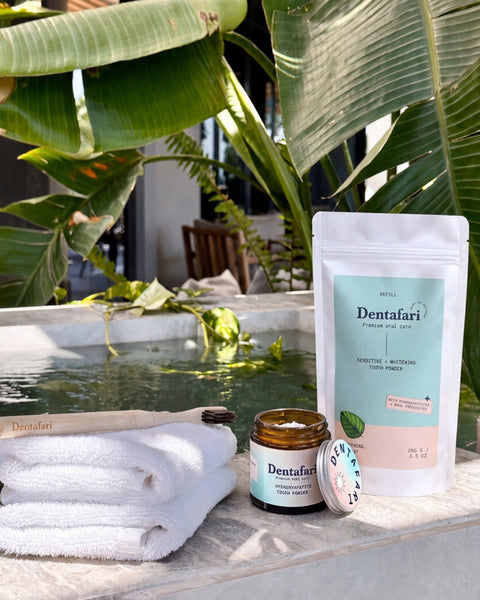
Oral Probiotics: What You Should Know About Your Oral Flora
Right now, billions of bacteria are living in your mouth – more than 700 different species colonise your tongue, palate, teeth and gums. The vast majority of them aren’t enemies, but part of a finely tuned interplay: your oral microbiome.
For a long time, oral care was almost entirely about removing bacteria. Today, research is taking a closer look and asking which species belong to a healthy mouth and how their balance can be supported. This is exactly where oral probiotics come in.
What the oral microbiome actually is
The oral microbiome is a community of bacteria, fungi and other microorganisms on the tongue, teeth, gums and oral mucosa. It’s as individual as a fingerprint and changes with diet, time of day, lifestyle and care habits. Together, these microorganisms form the environment that surrounds your enamel and gums every day.
The mouth is the first stop: everything you eat, drink or breathe passes through it first, and when you swallow, microorganisms travel on into the digestive tract. How a balanced oral environment relates to general wellbeing is still being researched – a field that is only just beginning. How this perspective is changing oral care is explained in detail in Microbiome toothpaste: probiotics and enzymes fact-checked.
When the balance is thrown off
If the balance is upset, it can show up as less fresh breath, an unpleasant feeling in the mouth or sensitive spots. Some phases of life – hormonal changes, stress, a change in diet – can influence the composition of the oral flora.
The obvious idea: support the species that belong to a healthy mouth, rather than going after everything indiscriminately.
Probiotics, prebiotics, postbiotics: the difference
Probiotics are live bacterial strains. Prebiotics are substances that serve as food for beneficial bacteria, such as acacia gum or xylitol. Postbiotics, according to the definition of the International Scientific Association for Probiotics and Prebiotics, are preparations of inactivated microorganisms or their components [1]. The bacteria are no longer alive, but their cell structure and constituents are largely preserved.
For oral care, this difference is practical: live cultures don’t cope well with being stored in the bathroom. Heat-treated postbiotics are stable, need no refrigeration and are therefore suitable for a tooth powder.
Our strain: Lactobacillus plantarum HEAL19
Our Sensitive flavours contain Lactobacillus plantarum HEAL19, an isolated strain selected for oral care. It is gently heat-treated and so contains no live cultures at all. The processing preserves the bacteria’s natural cell structure and provides a range of bioactive components, including polysaccharides, peptides, organic acids, vitamins and minerals. The ingredient is COSMOS-certified.
It supports a healthy balance of the oral microbiota and contributes to a balanced oral environment. In the ingredients list, you’ll find it as “Lactobacillus Ferment”, bound to acacia gum (Acacia Senegal Gum), a plant fibre with a prebiotic effect.
What research says
Lactobacillus plantarum is one of the best-studied lactic acid bacteria. A review in the Journal of Oral Microbiology summarises how strains of this species interact with the oral flora and the mucosa [2]. An ex vivo model examined how selected probiotic strains interact with human cells [3]. Acacia gum has also been studied in the laboratory, including its influence on tooth enamel [4].
To put this in context: these are laboratory and cell models, not studies on people who have used our tooth powder. Results apply to the strain examined and can’t simply be transferred. That’s why we describe the effect of our postbiotic exactly as far as the evidence goes: it supports the natural balance of the oral flora.
Two flavours with a postbiotic
We’ve deliberately put the postbiotic only in our two Sensitive flavours. Both combine the postbiotic with hydroxyapatite, which supports the natural remineralisation of tooth enamel. What this mineral is all about is explained in What is hydroxyapatite?

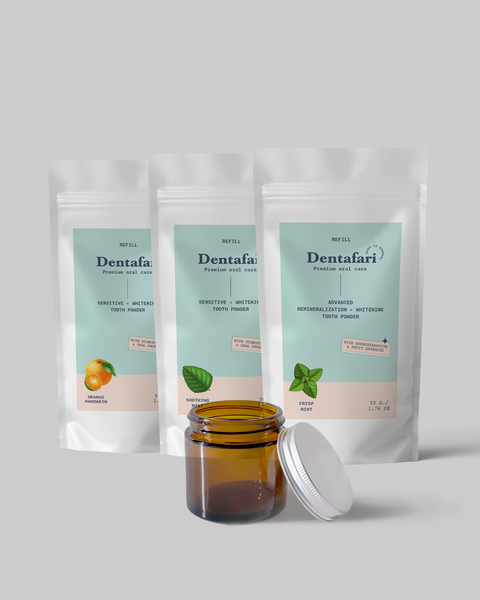
A gentle mint note for anyone who likes it fresh but not sharp. Hydroxyapatite supports the natural remineralisation of tooth enamel, xylitol contributes to a balanced oral environment, and the postbiotic supports the natural balance of the oral flora. No nano particles. Mineral · With plant-based ingredients · Refillable · Made in Germany.

Purely fruity, for children aged three and up and for anyone who’d rather skip mint in the morning. Hydroxyapatite, xylitol and the same postbiotic as in Soothing Mint. No nano particles. Mineral · With plant-based ingredients · Refillable · Made in Germany.
If your teeth react sensitively, Tooth powder for sensitive teeth guides you through the choice. How tooth powder works in the first place is explained in our comparison Toothpaste or tooth powder.
What you can do for your oral flora yourself
Your daily routine matters more than any single product. A balanced diet that’s fairly low in sugar and acid is good for the oral environment, as is drinking enough water through the day. Gently cleaning your tongue as well removes the coating where bacteria collect. And when brushing: better mild and regular than hard and rare.
If a dry mouth or bad breath is what’s on your mind, you’ll find causes and everyday tips in Dry Mouth: Why Saliva Matters So Much for Your Teeth and Bad Breath: Where It Comes From and What Actually Helps.
Questions we’re often asked
What are oral probiotics?
Oral probiotics are selected bacterial strains for the mouth. They are meant to support a balanced oral environment rather than remove bacteria indiscriminately. Dentafari contains the strain Lactobacillus plantarum HEAL19 – heat-treated, with no live cultures.
What’s the difference between probiotics and postbiotics?
Probiotics are live bacteria. Postbiotics are heat-treated bacteria that are no longer alive, whose cell structure and components are largely preserved. They are stable, need no refrigeration and are therefore very well suited to cosmetic products or tooth powder.
Which flavours contain the postbiotic?
The two Sensitive flavours, Soothing Mint and Orange-Mandarin. Crisp Mint relies instead on the fruit enzymes papain and bromelain and activated charcoal.
Are these live cultures?
No. The strain is heat-treated and therefore stable – with no live cultures at all. In the ingredients list, it appears as “Lactobacillus Ferment”.
Is Dentafari vegan?
Yes, all flavours are vegan.
If you like, think of your two minutes morning and evening not as a chore, but as a small moment for yourself. You’ll find all flavours and sizes in the overview Tooth powder with hydroxyapatite.
Your new oral care starts here.
Discover the Sensitive tooth powder Soothing Mint with hydroxyapatite, xylitol and a postbiotic. Mineral · With plant-based ingredients · Refillable · Made in Germany.
Discover now →Sources
- Salminen S et al. (2021): The International Scientific Association of Probiotics and Prebiotics (ISAPP) consensus statement on the definition and scope of postbiotics. Nat Rev Gastroenterol Hepatol 18:649–667. https://doi.org/10.1038/s41575-021-00440-6
- The role of Lactobacillus plantarum in oral health: a review of current studies (2024). J Oral Microbiol 16(1):2411815. https://doi.org/10.1080/20002297.2024.2411815
- Schmitter T et al. (2018): Ex vivo anti-inflammatory effects of probiotics for periodontal health. J Oral Microbiol 10(1):1502027. https://doi.org/10.1080/20002297.2018.1502027
- Onishi T et al. (2008): Remineralization effects of gum arabic on caries-like enamel lesions. Arch Oral Biol 53(3):257–260. https://doi.org/10.1016/j.archoralbio.2007.10.004
Bestsellers
Comments (0)
There are no comments for this article. Be the first one to leave a message!