
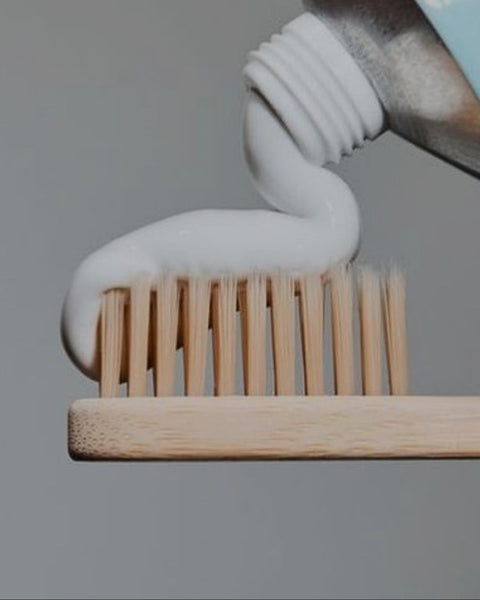
Toothpaste vs. Tooth Powder: The Natural Alternative for Healthy Teeth
Twice a day, every day — most of us have been reaching for toothpaste since childhood. Not because it's the only way, but because it's what we're used to. Yet tooth powder is not a new invention. It's the older one. And right now it's experiencing a very thoughtful comeback.
What is tooth powder?
97 per cent of your tooth enamel is made up of a mineral called hydroxylapatite. Most toothpastes don't contain it. Tooth powder can — in a form that closely resembles natural tooth structure.
Tooth powder is a dry form of oral care — no water, no binders, no carrier substances that make a tube a tube in the first place. What remains are the active ingredients themselves: minerals, natural cleansing particles, essential oils. Sometimes probiotics. Sometimes plant-based enzymes.
Conventional toothpaste is about 80 per cent water, thickeners and stabilisers. The remaining 20 per cent is what actually works. Tooth powder flips this ratio around.
What's in high-quality tooth powder
The difference starts with the ingredient list. Good tooth powder has a short one — and no substances that require a second read.
Hydroxylapatite is the ingredient that sets tooth powder apart from most toothpastes. It's the same mineral that your tooth enamel is made of. In modern oral care products, it's valued for its ability to support natural remineralisation of tooth enamel — and contribute to a naturally brighter appearance of teeth. Fluoride works differently — and many people are looking for an alternative. Tooth powder with hydroxylapatite is one option.
Xylitol — a natural sugar alcohol. It's non-fermentable and helps keep the mouth environment less acidic. A condition that tooth enamel appreciates.
Sodium Cocoyl Glutamate — a mild, coconut-based foaming agent. It cleanses gently and is mild to the oral mucosa.
Some formulations go further. Oral probiotics — such as Lactobacillus plantarum HEAL19 — address the oral microbiome directly. Your mouth is home to over 700 different bacterial species. The idea is not to kill them all, but to support balance. Plant-based enzymes like Bromelain and Papain dissolve the protein-rich pellicle from the tooth surface — that's the organic layer where discolouration becomes fixed.
Who tooth powder is made for
For anyone who wants to know what they're putting in their mouth twice daily. Especially for people with sensitive teeth or sensitive gums — because of the gentle, mild cleansing and the mild surfactant. For parents who don't want to give their children ingredients they can't themselves make sense of. For anyone seeking fluoride-free oral care that is still scientifically backed.
Not all tooth powders are the same. What matters: genuine active ingredients instead of filler substances, an INCI list you can read, and a manufacturer who can explain their formulation.
What's the difference between toothpaste and tooth powder?
Consistency makes the difference
The most striking difference lies in the formula itself. Toothpaste consists largely of water, thickeners, foaming agents and preservatives — all of which are necessary to keep the creamy consistency stable and shelf-stable. The actual active ingredient content is often only around 20 per cent.

Tooth powder doesn't need any of that. No water, no emulsifiers, no stabilisers. What's in the jar is 100 per cent active ingredients — minerals, plant extracts, essential oils. The formula is so straightforward that you can read and understand it.
The historical perspective
Tooth powder, by the way, isn't an invention of modern natural cosmetics. Thousands of years ago, people used powdery substances for tooth cleaning — from the ancient Egyptians to the 19th century, when mixtures of chalk, salt and baking soda were widespread. Around 1850, toothpaste began gradually replacing powder — for practical and marketing reasons, not necessarily because of superior effectiveness.
Scientific evidence: What does research say?
Plaque removal
Two scientific studies from 2017 examined tooth powder and toothpaste in the context of surface staining and plaque. The results suggest that both forms can clean effectively — what matters is the formula, not the consistency.
Gentle brightening without aggressive bleaching agents
Instead of aggressive bleaching agents, tooth powder works mechanically: the mineral particles smooth the tooth surface and allow discolouration to disappear gently. The result is a naturally brighter appearance — without interfering with tooth structure.
Hydroxylapatite: The mineral from your tooth enamel
What is hydroxylapatite?
Hydroxylapatite is the mineral that makes up around 97% of your tooth enamel — literally the stuff your teeth are made of. In modern oral care, synthetically produced, biomimetic hydroxylapatite is used, which is very similar to natural tooth enamel in structure and composition.
What research examines
Hydroxylapatite is examined in numerous scientific studies — including in the context of tooth enamel remineralisation. There are clinical comparative studies on fluoride and hydroxylapatite. Studies show — you decide what works for you.
Dentafari's functionalised hydroxylapatite is created from highly pure natural calcium carbonate in a special recrystallisation process — with a calcium-phosphate ratio of 16.6 that is optimised for remineralisation. The porous structure supports the natural uptake of active ingredients.
The biomimetic approach
What's special about hydroxylapatite is that it's not a foreign substance for the body — it's the same mineral that tooth enamel is made of. It bonds directly with the tooth surface, contributes to smoothing and supports natural remineralisation. Without aggressive chemistry, without intervention.
Oral probiotics: Focus on the microbiome
Why the oral microbiome matters
Your mouth is not a sterile system. It is home to billions of microorganisms — a complex balance that changes daily through diet, habits and external influences. Modern oral care takes a closer look: not just cleaning, but actively supporting the natural balance.
Lactobacillus plantarum HEAL19: Scientifically backed probiotics
Dentafari relies on the strain Lactobacillus plantarum HEAL19 — heat-treated and stable, without any live cultures. It is valued for supporting the natural balance of oral flora and contributing to a balanced oral environment. A COSMOS-certified ingredient.
Acacia Senegal: Natural support
Additionally, Dentafari contains Acacia Senegal Gum — a natural polysaccharide that is valued for its care properties and can contribute to a balanced oral environment.
The benefits of tooth powder at a glance
For tooth health
Tooth powder contains no carrier substances, no water, no consistency agents. What you get is 100 per cent active ingredients — more concentrated than any toothpaste. The mineral cleansing particles work mechanically and gently at the same time: they smooth the tooth surface, contribute to a naturally brighter appearance and support natural remineralisation of tooth enamel. Low abrasivity makes tooth powder gentle on sensitive teeth — and the slightly alkaline pH supports a balanced oral environment.
For health
Tooth powder comes without sodium lauryl sulphate (SLS), without triclosan, without parabens and without artificial dyes. The plant-based foaming agent Sodium Cocoyl Glutamate, derived from the coconut fruit, provides a pleasant foaming experience without irritation — biodegradable and well tolerated. The formula is selected so that it is suitable for the whole family.
For the environment
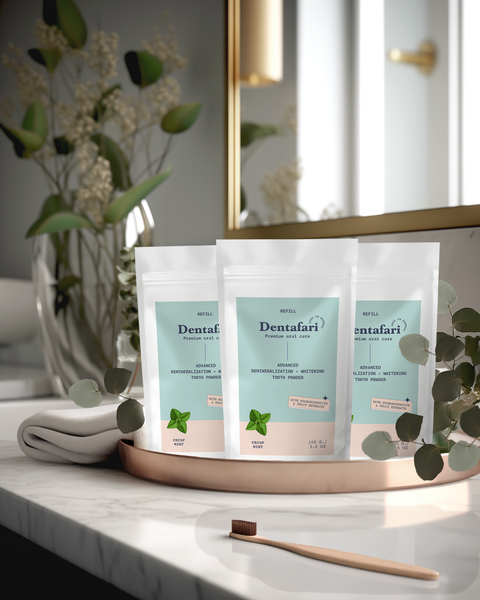
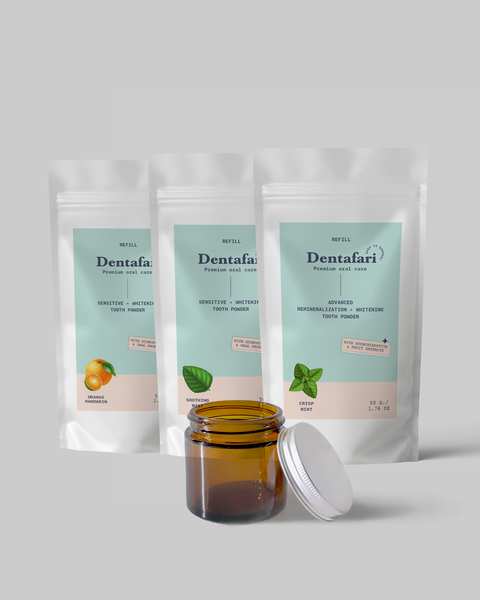
No water in the formula means less volume, less packaging, less transport. Dentafari uses brown glass jars that you keep and refill again and again, and recyclable refill pouches. No microplastics, no plastic tube waste. The recycling rate for glass in Germany is over 80 per cent — and a jar that stays permanently doesn't even enter this cycle.
For everyday life
Tooth powder is extremely economical — a 100g refill lasts — depending on how often you brush — around 4 months. Stored dry, it stays fresh for a long time without losing quality. When travelling: compact, leak-proof, no liquid restrictions.
Application: How to use tooth powder correctly
Step by step
The switch is easier than you might think. After one or two applications, the routine is as familiar as with toothpaste.

- Store correctly: Transfer the tooth powder to a clean, completely dry container and seal it tightly. This keeps the powder fresh and effective.
- Remove powder: Apply a small amount of powder to a dry, soft toothbrush. Tip: Start dry, then briefly dampen in between.
- Brush and rinse: Brush for about two minutes, then rinse thoroughly. Seal the container tightly again afterwards.
Tip: Let the tooth powder sit on your teeth for a moment after brushing so the hydroxylapatite can work.
Gentle foam from nature
Dentafari uses Sodium Cocoyl Glutamate, derived from the coconut fruit. This plant-based foaming agent is particularly mild to the sensitive oral mucosa, biodegradable and leaves no unpleasant aftertaste. The result: a delicate foaming experience that feels pleasant — without irritation, without synthetic foaming agents.
Common concerns and myths
"Tooth powder is too abrasive"
This myth persists, but doesn't reflect the reality of modern formulations. The abrasivity of high-quality tooth powder is within the recommended range for daily use. The grain size and nature of the minerals used determine this — and modern formulations excel here with finely ground, enamel-friendly particles.
"Without fluoride it can't be effective"
There are clinical studies on hydroxylapatite and fluoride. Studies show — you decide what works for you. Hydroxylapatite is also suitable for people who want to or need to avoid fluoride.
"The application is awkward"
After a short adjustment period, tooth powder is just as straightforward as toothpaste. Many users appreciate the precise dosing and the feeling of knowing exactly what they're using.
Tooth powder compared: What to look out for
Quality features
Not all tooth powders are the same. Look for high-quality, scientifically backed active ingredients such as hydroxylapatite, natural minerals and oral probiotics where appropriate. Reputable manufacturers list all ingredients transparently and can substantiate effectiveness through studies. Production to European quality standards ensures rigorous controls — as does a neutral to slightly alkaline pH that protects tooth enamel.
Dentafari's scientific approach
Dentafari combines a natural approach with modern research: functionalised hydroxylapatite from highly pure calcium carbonate for natural remineralisation, Lactobacillus plantarum HEAL19 for a balanced oral environment, Acacia Senegal Gum for gentle care. Free from SLS, triclosan, microplastics and synthetic dyes — all on a clear INCI list.
Who is tooth powder suitable for?
Tooth powder with hydroxylapatite is suitable for anyone who wants to understand what they're using daily. For people with sensitive teeth, because the low abrasivity is gentle on enamel. For children — Dentafari offers special formulations for young teeth. For people with sensitive oral mucosa, allergy sufferers with intolerances to certain toothpaste ingredients, vegans — the probiotic technology is based on plant ferments. And for anyone who wants to pack compactly when travelling, leak-proof and without liquid restrictions.
In short: If you read INCI lists, if you want to know what's inside, if you're looking for a routine that feels good — this is for you.
Discover our tooth powder with hydroxylapatite and start your two minutes for you. 🦷🌿
Your questions about tooth powder
Can I switch from toothpaste to tooth powder immediately?
Yes, you can switch at any time. Dentafari has a pleasant, light foaming experience thanks to the natural foaming agent Sodium Cocoyl Glutamate — the switch feels more familiar than expected.
Is tooth powder suitable for children?
Yes. Dentafari offers special formulations for young teeth.
How long does a refill last?
A 100g refill lasts — depending on how often you brush — around 4 months — much longer than a tube of toothpaste.
Does tooth powder stain teeth?
No — quite the opposite. Tooth powder with hydroxylapatite provides a naturally brighter appearance through surface smoothing. Crisp Mint also contains papain and bromelain for gentle, enzymatic cleaning — without bleaching agents.
Which tooth powder for tooth brightening?
All Dentafari formulations contribute to a naturally brighter appearance through hydroxylapatite. Crisp Mint combines hydroxylapatite with papain (papaya enzyme) and bromelain (pineapple enzyme) — gently, mechanically, without peroxides.
Can I use tooth powder with an electric toothbrush?
Yes, no problem — with manual and electric toothbrushes.
Do I need a mouthwash after tooth powder?
No. Tooth powder cleanses and cares comprehensively. Mouthwash can be used additionally, but is not necessary.
Sources and scientific references
- Studies on the effectiveness of tooth powder vs. toothpaste in plaque removal (2017)
- Tschoppe et al. (2011): Tooth enamel and dentine remineralisation by nano-hydroxylapatite toothpastes, Journal of Dentistry
- Schlagenhauf et al. (2019): Multi-centre study on caries prevention with hydroxylapatite over 18 months
- Enax et al. (2020): Hydroxylapatite as a biomimetic active ingredient for remineralisation, ZWR - Das Deutsche Zahnärzteblatt
- Limeback et al. (2021): Biomimetic hydroxylapatite and caries prevention – Systematic review and meta-analysis
- Symrise Oral Care Consumer Study (2020): Consumer expectations of modern oral care products
- Onishi et al. (2008): Remineralisation effects of acacia gum on caries-like tooth enamel lesions, Archives of Oral Biology
More on tooth powder
Bestsellers
Comments (0)
There are no comments for this article. Be the first one to leave a message!