Gum recession affects millions of people worldwide. Proper dental care can help to slow down the process and provide relief. Find out how gentle dental care with scientifically proven ingredients can help.

What is gum recession and why does it occur?

Gum recession (gingival recession) is a common problem where the gums recede from the crown of the tooth, exposing the sensitive tooth necks. This is not just an aesthetic problem - if left untreated, receding gums can lead to tooth loss.

The most common causes of receding gums:

  • Incorrect brushing technique: scrubbing too hard with hard bristles
  • Aggressive toothpastes: High RDA values damage the gums
  • Periodontitis: Bacterial inflammation destroys the gum tissue
  • Teeth grinding: Overexertion at night weakens the periodontium
  • Genetic predisposition: Thin gums are more susceptible to recession

Important: Advanced gum recession does not usually regenerate on its own. However, adapted dental care can have a supportive effect and should always be carried out in consultation with a dentist.

The right choice of toothbrush: Gentle but effective

Soft bristles are a must

Scientific studies clearly show that toothbrushes with soft bristles are the best choice for receding gums. Hard bristles can cause micro-injuries to the gum line and aggravate existing recession.

Optimal are:

  • Soft bristles (0.15-0.18 mm diameter)
  • Rounded or tapered bristle ends to protect the gums
  • Compact brush heads for better accessibility

Sonic toothbrushes: the gentle alternative

Sonic toothbrushes generate up to 96,000 vibrations per minute and clean using liquid currents - without aggressive scrubbing. Studies show that they remove plaque more effectively than manual toothbrushes and are gentle on the gums.

Bamboo toothbrushes: sustainable and gentle

Modern bamboo toothbrushes with soft nylon bristles offer an environmentally friendly alternative. Important: Make sure the bristles are soft here too!

Why aggressive toothpastes aggravate gum recession

The RDA value (abrasiveness) is decisive

The RDA value (Relative Dentin Abrasion) indicates how abrasive a toothpaste is. The RDA value should be relatively low for receding gums.

RDA categories:

0-30: Very little abrasive (often too weak cleaning)

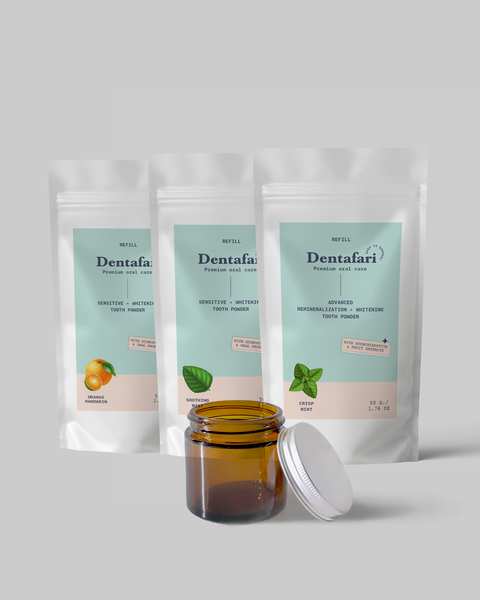
30-50: Low abrasive(optimal for receding gums), like our tooth powder for sensitive teeth

50-80: Medium abrasive (for healthy teeth), like our tooth powder remineralizing tooth whitening

80+: Highly abrasive (aggravates gum recession)

However, it should be noted that the RDA value is not a completely appropriate method for assessing the safety of toothpastes according to current scientific knowledge. Laboratory results cannot be directly transferred to daily use, as important factors such as toothbrush type, brushing pressure and saliva are not taken into account. In addition, the same toothpastes can have very different RDA values in different test laboratories, which limits comparability.

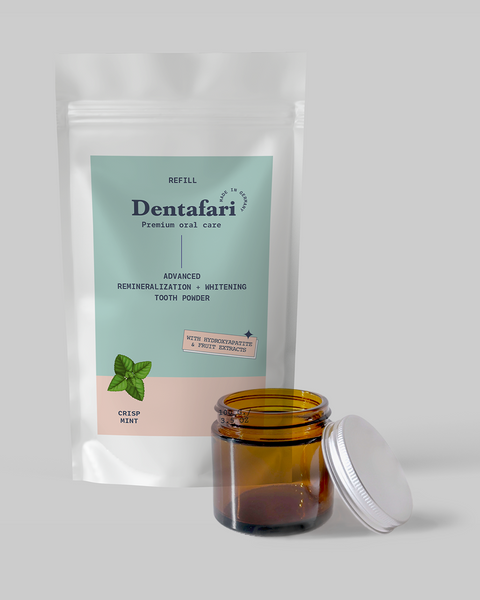
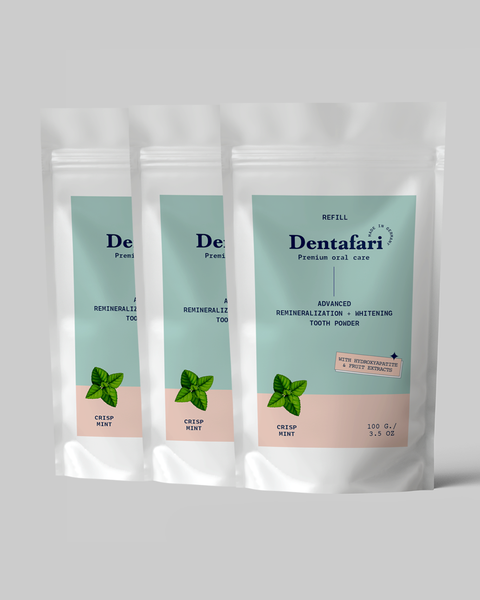
All Dentafari toothpowder products have an optimal balance of tooth structure protection and cleaning performance and are safe for daily use in terms of their abrasiveness according to international standards.

Avoid problematic ingredients

Sodium Lauryl Sulfate (SLS) can irritate the oral mucosa and increase inflammation. Mild surfactants such as sodium cocoyl glutamate - a coconut-based surfactant that gently cleanses without irritating - are better.

The power of enzymes: papain and bromelain for healthy gums

Proteolytic enzymes such as papain (from papaya) and bromelain (from pineapple) are revolutionizing modern dental care. Randomized controlled studies show impressive results:

Papain - The gentle plaque remover

  • Anti-plaque effect: up to 50% less plaque formation
  • Inflammation inhibition: Significant reduction of gingivitis
  • Protein cleavage: Biochemically dissolves bacterial biofilms

Bromelain - the anti-inflammatory

  • Biofilm reduction: Significant reduction in bacterial adhesion
  • Promotes blood circulation: Supports gum regeneration
  • Synergy effect: Enhances the effect of papain

How enzymes protect the gums

The enzymes attack the protein matrix of the plaque at various points and dissolve it biochemically - without mechanical friction. This is particularly gentle on already damaged gums.

Probiotics for oral health: the future of dental care

Lactobacillus plantarum HEAL19 - the first optimized probiotic for oral hygiene

69% of consumers are in favor of toothpastes with probiotics. Lactobacillus plantarum HEAL19 is a probiotic strain specially developed for oral care with impressive properties:

Scientifically proven benefits:

  • Strengthening the oral mucosal barrier
  • Promotion of healthy oral flora
  • Reduction of harmful bacteria
  • Support of the natural defenses

Innovation meets science

Lactobacillus plantarum HEAL19 is a heat-pretreated probiotic that retains its cell wall structure and can therefore develop its biological activity without the need for live bacteria.

Hydroxyapatite: remineralization instead of abrasion

The enamel building block

Hydroxyapatite is identical to natural tooth enamel and offers unique advantages:

  • Remineralization: repairs microcracks in the enamel
  • Brightening: Smoothes the tooth surface for natural brightness
  • Low abrasiveness: Protects sensitive tooth necks
  • No aftertaste: Pleasant to use

Studies show: Dentafari's specially functionalized hydroxyapatite achieves up to 67% restoration of microhardness - significantly better than conventional nano or micro variants.

Dentafari tooth powder products combine:

  1. Proteolytic enzymes (papain & bromelain)
  2. Probiotics (Lactobacillus plantarum HEAL19)
  3. Functionalized hydroxyapatite
  4. Mild surfactant (sodium cocoyl glutamate)

Why this combination works:

Enzymatic plaque removalProbiotic oral flora balanceRemineralizationGentle cleaning

Practical tips for daily dental care with receding gums

The right brushing technique

  • Shaking method: Small, circular movements instead of horizontal scrubbing
  • 45-degree angle: Align bristles with the gum pocket
  • Gentle pressure: Maximum 150 grams (as much as hand pressure)
  • 2-3 minutes: Sufficient time for enzymatic action

Timing is crucial

In the morning: Enzymes activate the immune system

Evening: long-term effect overnight

After acidic food: wait 30-60 minutes

Supplementary measures

  • Tongue cleansing: Reduces bacterial load
  • Oil pulling: Traditional Ayurvedic practice (coconut oil)
  • Professional teeth cleaning: Every 3-6 months

When to go to the dentist? The Miller classification

According to Miller, gum recession is divided into 4 classes:

Class I-II: Often reversible with proper care

Class III-IV: Surgical treatment required

Warning signals:

  • Visible tooth necks
  • Increased sensitivity to temperature
  • Bleeding gums
  • Longer teeth

Conclusion: Gentle dental care is effective dental care

Gum recession can be successfully treated with the right combination of gentle brushing technique and scientifically proven ingredients. The synergy of proteolytic enzymes, probiotics and functionalized hydroxyapatite offers a holistic approach to healthy teeth and gums.

The solution lies not in more power, but in more science. Discover Dentafari tooth powder here.

This article contains general information only and should not be used for self-diagnosis or self-treatment. It is not a substitute for a visit to the doctor.

Sources

Gingival Recession - Causes and Management. Prim Dent J. 2020 Jan 29;8(4):40-47. https://pubmed.ncbi.nlm.nih.gov/32127093/

RDA does not correlate with actual oral abrasion, Today's RDH (2023), https://www.todaysrdh.com/relative-dentin-abrasivity-rda-not-just-a-simple-number/

Imfeld study on RDA standard procedures, Imfeld, T. (2010). "Standard operation procedures for the relative dentin abrasion (RDA) method used at Zurich University", https://www.researchgate.net/publication/278753279_Standard_operation_procedures_for_the_relative_dentin_abrasion_RDA_method_used_at_Zurich_University

RDA values are not internationally comparable, IWW Dental (CME article), https://www.iww.de/zr/allgemeine-zahnheilkunde/cme-beitrag-abrasionswerte-rda-wert-angabe-auf-zahnpasten-soll-wegfallen-f141681

Correlation study RDA vs. actual abrasion, ResearchGate (2023). "Toothpaste Abrasion and Abrasive Particle Content: Correlating High-Resolution Profilometric Analysis with RDA", https://www.researchgate.net/publication/369221358_Toothpaste_Abrasion_and_Abrasive_Particle_Content_Correlating_High-Resolution_Profilometric_Analysis_with_Relative_Dentin_Abrasivity_RDA

Different measurement methods between USA and Switzerland, Smilestore Scientific Review, https://www.smile-store.de/magazin/zahnpflege-infos/der-rda-wert-wie-abrasiv-ist-meine-zahnpasta

"Evaluation of the efficacy of enzyme-containing toothpaste in reducing plaque and gingivitis." Journal of Clinical Periodontology, https://pubmed.ncbi.nlm.nih.gov/2135601

Multiple studies review (2024). "The role of Lactobacillus plantarum in oral health: a review of current studies." Frontiers in Microbiology, https://pubmed.ncbi.nlm.nih.gov/39444695/, https://pmc.ncbi.nlm.nih.gov/articles/PMC11497578/

Fenster, K. et al. (2024). "Probiotics for oral health: a critical evaluation of bacterial strains." Frontiers in Microbiology, https://www.frontiersin.org/journals/microbiology/articles/10.3389/fmicb.2024.1430810/full

Characterization of oral lactobacilli as potential probiotics for oral health. Archives of Oral Biology, https://pubmed.ncbi.nlm.nih.gov/18279182/

https://www.dentafari.com/blogs/dentafari-blog-zahnpflege-mundgesundheit-tipps/die-enzym-revolution-wie-papain-und-bromelain-ihre-zahnpflege-transformieren

D'Agostino, S. et al. (2024). "Effect of Probiotics Lactobacillus rhamnosus and Lactobacillus plantarum on Caries and Periodontal Diseases: A Systematic Review." Dentistry Journal, https://www.mdpi.com/2304-6767/12/4/102

FAQ - Frequently asked questions about gum recession

What happens with receding gums?

The gum tissue recedes and exposes the sensitive tooth necks. This can lead to hypersensitivity, an increased risk of tooth decay and esthetic problems.

What can be done if the gums recede?

The first step is always a visit to the dentist. He or she will determine the cause and initiate appropriate treatment, which can range from adjusting oral hygiene to surgical procedures.

Can receding gums recover?

No, lost gum tissue does not regenerate by itself. However, it can be surgically restored.

What home remedies help with receding gums?

Home remedies such as tea tree oil or certain mouthwashes can reduce inflammation, but they cannot rebuild the lost tissue. They should only ever be used in consultation with your dentist.

Can I whiten my teeth with receding gums?

No, tooth whitening should be avoided. The bleaching agents can further irritate the sensitive tooth necks and cause pain.

Which toothpaste for receding gums?

There are special toothpastes for sensitive teeth that can reduce sensitivity to pain. You should choose a toothpaste with a low RDA value (abrasiveness).

Can gum recession be stopped?

Yes, by eliminating the causes, such as aggressive brushing technique or periodontitis, gum recession can be stopped. gum recession can be stopped.

Does diet play a role?

Yes, a balanced, vitamin-rich diet (especially vitamin C) strengthens the gum tissue and can support oral health.


Disclaimer:

This article is for general information and does not replace professional dental advice. You should always consult a qualified dentist if you have any complaints.