

Hydroxyapatite Tooth Powder: The Safety of Nano-Hydroxyapatite
Hydroxylapatite toothpaste and hydroxylapatite tooth powder are gaining recognition as an alternative to fluoride oral care. But whilst tooth remineralisation with hydroxylapatite sounds promising, critical questions arise about nano hydroxylapatite safety. At Dentafari, we encourage you to examine nano hydroxylapatite risks carefully before deciding on a product.
What is hydroxylapatite in oral care?
Hydroxylapatite (HAP) is a crystalline form of calcium phosphate – the building block that makes up 97% of your teeth. Only about 1.5% is protein (mainly collagen) and 1.5% water.
The crucial difference: not every hydroxylapatite tooth powder is the same. Tooth remineralisation depends heavily on the type of hydroxylapatite used.
Natural vs. nano hydroxylapatite: critical safety considerations
Many hydroxylapatite toothpaste manufacturers speak broadly of "hydroxylapatite" without explaining the decisive differences.
Natural hydroxylapatite: low solubility; at Dentafari, we deliberately use it without nano particles (particle size over 100 nm).
Nano hydroxylapatite: laboratory production from synthetic components, nanoparticles with unclear long-term effects, unresolved safety concerns.
Current EU regulation on nano hydroxylapatite safety
After years of review, the European Union published its Revised Final Opinion on nano hydroxylapatite risks in March 2023:
"Based on the data provided, the SCCS considers hydroxylapatite (nano) to be safe when used at concentrations up to 10% in hydroxylapatite toothpaste and up to 0.465% in mouthwash."
Critical note: This safety assessment applies only to very specific particles: rod-shaped particles (at least 95.8% with an aspect ratio below 3) and uncoated, non-surface-modified nanoparticles.
Unresolved nano hydroxylapatite risks
The scientific assessment reveals several problematic aspects:
Missing long-term data: No studies exist on long-term effects from daily use.
Conflict of interest in research: Safety studies were conducted by manufacturer Fluidinova itself.
Limited test conditions: New tests were conducted only in vitro (test tube) for 4 hours.
Regulatory gaps: As a consumer, you cannot verify whether your hydroxylapatite tooth powder contains safe rod-shaped or concerning needle-shaped particles.
Studies on nano hydroxylapatite risks in detail
The Scientific Committee on Consumer Safety identified several nano hydroxylapatite risks:
"The available evidence was insufficient to draw a conclusion regarding the safety of hydroxylapatite (nano) when used in oral cosmetic products."
Specific investigated risks: potential cellular damage in kidney cells¹, possible negative effects on human blood cells², unclear genotoxic potential³.
A 2019 Nature study examined nano hydroxylapatite safety under laboratory conditions. Although no short-term toxicity was detected, questions about long-term safety remain unanswered.
Dentafari's approach: hydroxylapatite without nano particles
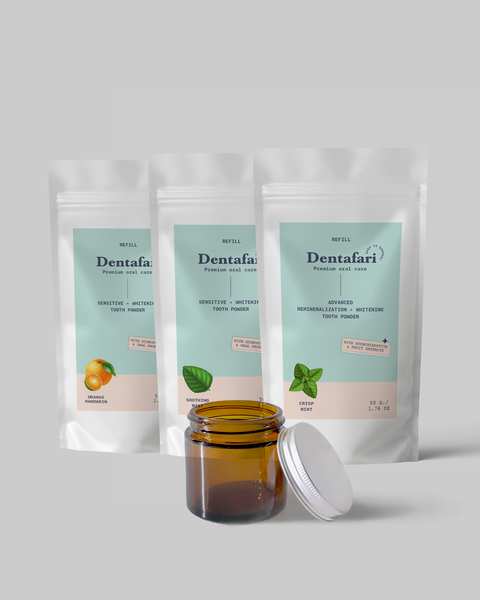
At Dentafari, we rely on functionalised natural hydroxylapatite tooth powder – deliberately without synthetic nanoparticles.
Our functionalised hydroxylapatite: natural calcium carbonate as raw material, recrystallisation for optimised surface properties, porous particles without nanoparticles, supports natural tooth enamel remineralisation, provides a naturally brighter appearance through surface smoothing.
Natural alternatives for tooth remineralisation
A groundbreaking study compared natural remineralisation using eggshell with nano hydroxylapatite: natural eggshell showed identical remineralisation results to synthetic nanoparticles⁴.
Why Dentafari hydroxylapatite tooth powder
We follow the precautionary principle. As long as nano hydroxylapatite risks cannot be fully ruled out, we use exclusively natural alternatives.
Our approach: natural hydroxylapatite without synthetic nanoparticles, support for natural tooth enamel remineralisation, probiotic technology for balanced oral flora — made in Germany.
The future of your oral care
Natural hydroxylapatite tooth powder offers all the benefits of tooth remineralisation – without the uncertainties of synthetic nanoparticles. Studies show – you decide what suits you.
¹ SCCS Opinion on hydroxyapatite (nano) in cosmetic products, 2021 – European Commission
² Coelho, C.C. et al. "Nano-hydroxyapatite in oral care cosmetics", Nature Scientific Reports, 2019
³ SCCS Revised Final Opinion on Hydroxyapatite (nano), March 2023
Discover the power of nature and try Dentafari hydroxylapatite tooth powder.
More at a glance: What is hydroxylapatite?
Your questions about hydroxylapatite & safety
Is hydroxylapatite harmful?
Hydroxylapatite is the mineral that makes up around 97% of your tooth enamel — not a foreign substance. We deliberately use it without nanoparticles. We've presented what the studies say neutrally – you decide.
Does Dentafari use nano hydroxylapatite?
No. We use functionalised natural hydroxylapatite, deliberately without nanoparticles (particle size over 100 nm).
Does hydroxylapatite have side effects?
For health-related questions, your dentist is your best point of contact. We present the research neutrally and link to the sources.
What does Dentafari hydroxylapatite consist of?
Highly pure natural calcium carbonate, functionalised through recrystallisation — without nanoparticles.
Bestsellers
Comments (0)
There are no comments for this article. Be the first one to leave a message!