
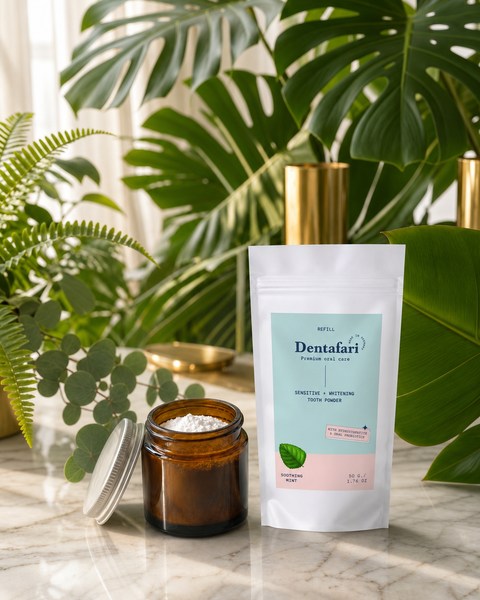
Using Tooth Powder Correctly: 5 Things Many People Get Wrong
You lift the lid, dip the brush in briefly and start brushing. Sounds right – and mostly it is. But we regularly get asked: "Am I sure I'm using the tooth powder correctly?" And the honest answer: There are a few points worth a second look.
Tooth powder isn't more complicated than toothpaste. It's actually simpler in some ways – but it behaves differently, and if you use it exactly like toothpaste, you're missing out on a bit of potential. Here are the five things we observe most often.
Mistake 1: Dipping the wet brush straight into the jar
It happens almost automatically because we're used to doing it with paste – dampen the brush, add product, done. With tooth powder there's just one small problem: moisture in the jar makes the powder clump and changes its texture over time. Plus, the wet brush carries water residue into the jar, which you don't want in the long run.
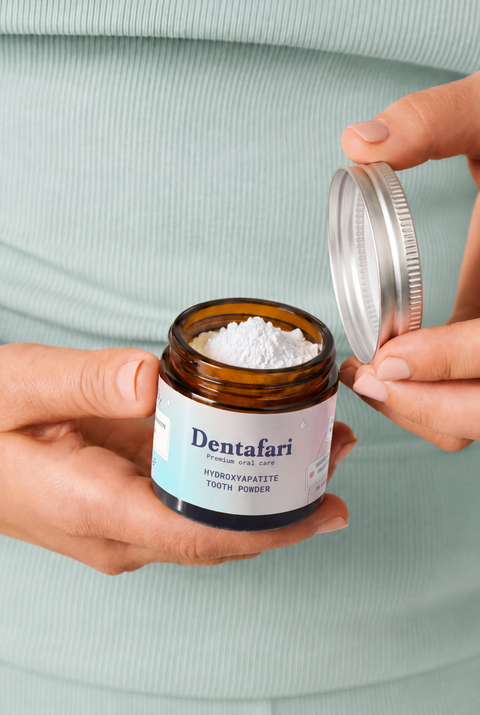
The simple solution: shake a small amount of powder directly onto the dry or only slightly dampened brush, or tap the brush briefly before putting it in the jar. Our brown glass jar comes with a small spatula – that works well too if you want to be particularly hygienic. Always close the jar properly afterwards.
Mistake 2: Taking too much
With toothpaste, we all learned the same visual language: a long stripe from one end of the brush to the other. That looks good on advertising posters, but it has little to do with the amount actually needed. With tooth powder this is even more relevant.
A small sprinkle – roughly pea-sized – is enough for your entire set of teeth. Those starting out with more often feel the powder froths too much or tastes too intense. That's because: even mild surfactants work effectively with very small amounts. You really don't need more.
A side effect that's often underestimated: a jar of Dentafari tooth powder lasts considerably longer than expected when dosed correctly.
Mistake 3: Rinsing immediately and thoroughly
This is deeply programmed because many toothpastes used to recommend: rinse vigorously, done. With a tooth powder based on hydroxylapatite it works a little differently.
Hydroxylapatite can help remineralise tooth enamel – the mineral adheres to your enamel and works best when it's given a moment's time. Vigorous, immediate rinsing with lots of water shortens this contact.
What works well: after brushing, simply spit out, rinse your mouth briefly with a little water – and that's it. The two minutes of brushing is plenty; the powder doesn't need to stay in your mouth afterwards for it to work. Those who prefer to rinse less can do so – not a must, just an option.
Mistake 4: Expecting it to feel exactly like paste
Toothpaste is a gel that sticks. Tooth powder is a powder that distributes differently. What comes from the brush onto your teeth is still enough for all surfaces – you don't need to reach for more or use more.
What we sometimes hear: "I feel like the powder only reaches my front teeth." That's true in the moment you start – but after just a few seconds of brushing, the powder distributes evenly with your saliva. The technique stays the same as always: outer surfaces, inner surfaces, chewing surfaces, two minutes each, with light pressure. Nothing different.
Those who favour the Bass technique – small circular movements at the gum line – are doing everything right with powder too. And if you've never heard of the Bass technique: your dentist will be happy to explain it – that's really their area.
Mistake 5: Storing the jar in the wrong place
Bathrooms are humid places. That sounds obvious, but it makes a difference with loose powders. A jar left open after brushing, with a damaged lid, or placed directly next to the shower gradually absorbs moisture from the air.
The powder clumps then not because of a product fault, but simply because of how it's stored. Our recommendation: always close the lid firmly after use and don't store the jar in the direct steam or splash zone. A small position change in the bathroom is usually enough.
So here's what your routine looks like
Briefly summarised, because not everyone likes to search: dry the brush or only lightly dampen it, take a small amount of powder (roughly pea-sized), brush for two minutes using your usual technique, then simply spit out or rinse minimally. Close the jar, store cool and dry.
That's all. And that's one of the things we really like about tooth powder.
What we're also asked frequently
Can I use the tooth powder for children too?
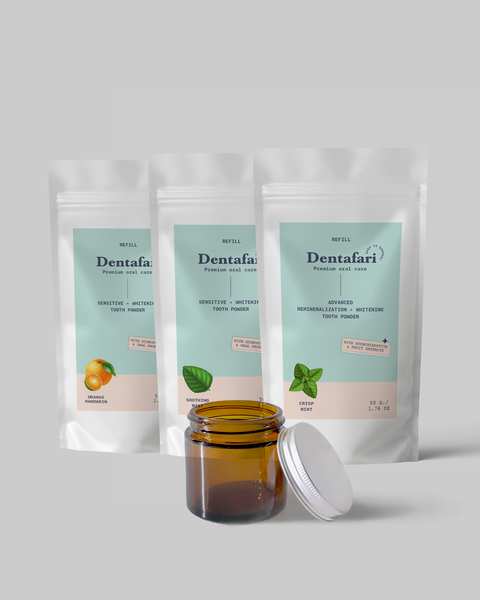
You'll find information about use in children – including age recommendations and safety advice – on the respective product page, for example with the mild Orange-Mandarin. If you have any questions, your dentist is also your best contact.
How long does a jar last with correct dosing?
With the 50g jar, the powder lasts – depending on how often you do your oral care routine – about 2 months. Most people underestimate how long a jar lasts.
Does the brush really need to be completely dry?
It doesn't need to be completely dry – a quick shake is enough. The main thing is not to dip a dripping wet brush into the jar.
The powder tastes very intense at first – is that normal?
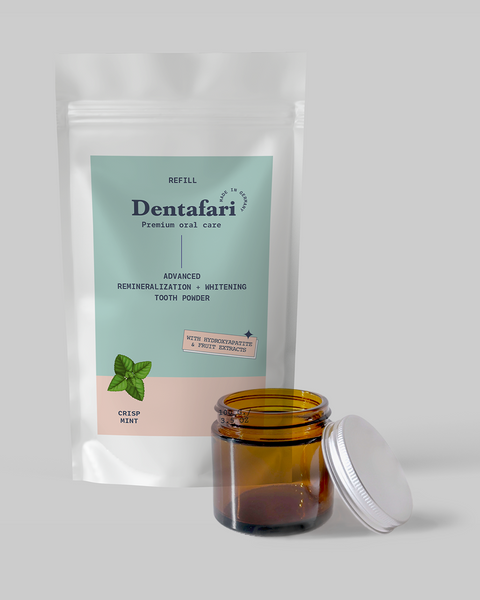
Yes, especially at first. It's almost always down to the amount. Use less, try it for a few days – then you'll adjust. And if you have Crisp Mint as your first choice: the peppermint intensity is deliberately stronger with this variety. Soothing Mint is milder if you prefer that.
Do I need to use mouthwash after brushing with tooth powder?
Not necessary. If you like mouthwash, you can of course use it. If you prefer to stick with the simple routine, you can get by without it – the powder handles your daily cleaning.
Is tooth powder in a jar hygienic?
Yes, if you dispense it dry. Put a small amount on your brush instead of dipping the damp brush into the jar, then close it again. This keeps the powder dry and clean – dryness is your best protection here.
Is tooth powder too abrasive?
That depends on the formulation and your brushing technique. We use finely ground particles for gentle cleaning. Technique is important: soft brush, light pressure, circular movements – no scrubbing.
Two minutes a day. A powder whose ingredients you can read. A routine that feels good.
Discover your ritual – find all varieties at buy tooth powder. And if you want to know what's actually in tooth powder and why it works, our overview of tooth powder is worth a read.
Bestsellers
Comments (0)
There are no comments for this article. Be the first one to leave a message!