
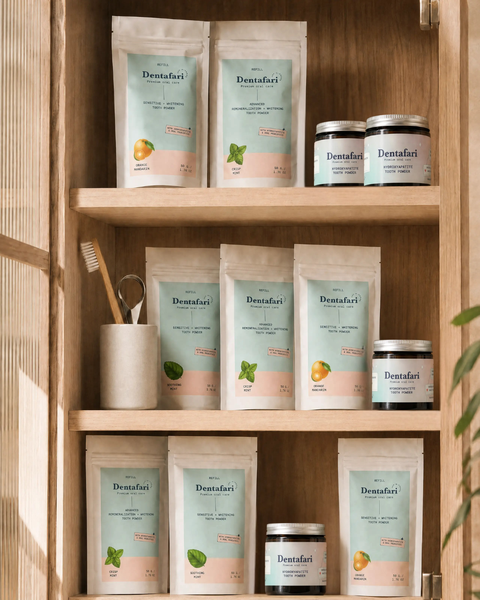
Microbiome Toothpaste: Why Probiotics and Enzymes Are Changing Oral Care
Maybe you’ve noticed it too: more and more toothpastes now say “microbiome” on the pack. According to Google Trends, searches for “microbiome toothpaste” in Germany rose by around 1,900 per cent within a year, and “building up oral flora” is one of the most searched questions around oral care. What’s behind the term? And why is everyone suddenly talking about probiotics and enzymes in the bathroom?
A microbiome toothpaste is oral care that supports the natural balance of the oral flora rather than removing as many bacteria as possible. To do this, it relies on mild cleaning particles and surfactants, on xylitol and hydroxyapatite, and on two ideas that are currently changing oral care: probiotics or postbiotics, which contribute to a balanced oral environment, and enzymes, which gently loosen deposits and stains. Research on this grows every year; the effects are moderate and depend on the specific bacterial strain. Studies show – you decide. Here you’ll find out what’s behind the trend, what science says about it and how to build up your oral flora in everyday life.
In this article
- What is a microbiome toothpaste?
- Why bacteria in your mouth aren’t the enemy
- How are probiotics changing oral care?
- Postbiotics: why heat-treated bacteria belong in tooth powder
- What do enzymes do in oral care?
- Five things the microbiome trend is changing
- Building up your oral flora: a routine that supports your microbiome
- What we honestly don’t know yet
- Questions we’re often asked
What is a microbiome toothpaste?
A microbiome toothpaste (or a microbiome tooth powder) is an oral care product that is gentle on the oral flora and supports its balance. Typical building blocks are mild surfactants such as Sodium Cocoyl Glutamate, xylitol, hydroxyapatite, prebiotics such as acacia gum, probiotics or postbiotics, and enzymes. The term isn’t a protected category. It describes an attitude: care rather than combat.
There’s a reason so many people are talking about it right now: in recent years, research has changed the way it looks at the mouth. Instead of asking how to get rid of as many bacteria as possible, it asks which species belong to a healthy mouth and how to support them [2]. The market is following suit: market analysts expect the market for oral microbiome products to more than double by 2033, with postbiotics growing fastest [1]. More and more people want oral care that is preventive rather than just cleaning. That sounds very much like the people we make Dentafari for.
In short: oral care is moving away from fighting bacteria towards caring for an ecosystem. That’s exactly the path we’ve followed since our very first tooth powder.
Why bacteria in your mouth aren’t the enemy
Do you know how many species of bacteria live in your mouth? More than 700. And the vast majority work for you. They buffer acids, they convert nitrate from vegetables into nitrite, which your body uses for the blood vessels, and they keep unwanted germs in check simply by being there. According to current understanding, caries and irritated gums don’t arise from “bacteria as such”, but when this balance tips. Experts call this dysbiosis. A much-cited review in the Journal of Dental Research sums it up: modern oral care should encourage the species that belong to a healthy mouth rather than removing them all [2].
A study at the University of Plymouth looked at what happens if you do it anyway [3]. 36 healthy adults rinsed with chlorhexidine twice a day for a week. Afterwards, the diversity in their mouths was lower, their saliva more acidic, its buffering capacity lower, and the nitrate-processing bacteria had decreased significantly. Chlorhexidine has its place, for example for a few days after a procedure. For daily care, this study shows one thing above all: how sensitively the ecosystem of the mouth reacts to blanket interventions.
That is the scientific core of the microbiome trend. And it explains why so many people are currently looking for ways to build their oral flora back up rather than fighting it.
How are probiotics changing oral care?
Oral probiotics are live bacterial strains intended to act in the mouth, usually lactobacilli or Streptococcus salivarius. Research describes three ways in which they influence the oral environment: they occupy sites on teeth and mucosa and take nutrients away from unwanted germs, they produce substances such as bacteriocins that slow the growth of individual species, and they interact with the mucosa, which responds to their presence.
How well has this been studied? The largest analysis summarises 50 randomised studies with more than 3,200 participants, and it shows a mixed picture [4]. Probiotics reduced the number of caries bacteria, and the gums were measurably better. Whether less caries actually developed, however, could not be demonstrated. A recent umbrella review of eleven meta-analyses reaches a similar conclusion: moderate effects, but noticeably less bad breath within a few weeks [5]. Two examples that stuck with me: in 72 marines, lozenges with Lactobacillus reuteri improved gum bleeding and plaque after six weeks, while the placebo group got worse [6]. And Streptococcus salivarius K12 led to fewer of the sulphur compounds that cause bad breath, especially when the tongue had been cleaned beforehand [7].
Important for context: “probiotics” isn’t a class of active ingredients but an umbrella term, and each result applies only to exactly the strain that was studied. Live cultures also have a very practical problem in toothpaste: they don’t cope well with water, surfactants and storage. This is exactly where the next development comes in.
| Term | What it is | Role in oral care |
|---|---|---|
| Probiotics | Live bacterial strains in a defined amount | Most useful as lozenges; hard to keep stable in toothpaste |
| Prebiotics | Substances that beneficial bacteria use as food, e.g. acacia gum or xylitol | Support a balanced oral environment, stable in any formula |
| Postbiotics | Heat-treated bacteria that are no longer alive, with their cell structure preserved | Stable in tooth powder and toothpaste, provide the complete bacterial spectrum |
Postbiotics: why heat-treated bacteria belong in tooth powder
According to the definition of the International Scientific Association for Probiotics and Prebiotics, postbiotics are “preparations of inanimate microorganisms and/or their components that confer a health benefit on the host” [8]. The bacteria are no longer alive, but their cell wall and constituents are largely preserved. You could say: the bacteria are gone, but everything they brought with them is still there.
Why this works is explained in a review in the International Journal of Molecular Sciences [9]. Cell wall components are in contact with the mucosa, surface proteins support the mucosal barrier, and many bacterial substances remain stable up to around 100 °C. That makes postbiotics suitable for everyday use: no fridge, no worries about shelf life in the bathroom, no transfer of resistance genes. In a small randomised study, 36 people in supportive periodontal care took a heat-treated Lactobacillus plantarum strain daily for twelve weeks, and their gums were measurably better afterwards than with placebo [10]. These data apply to the strain studied there and can’t be transferred to others. Studies show – you decide.
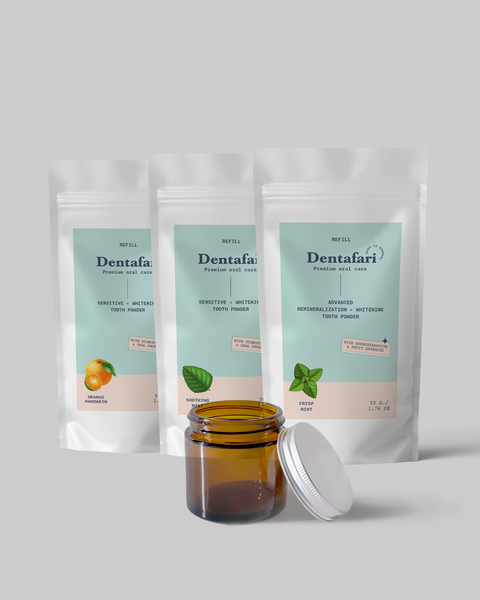
At Dentafari, we use exactly this principle. An isolated strain, Lactobacillus plantarum HEAL19, is gently heat-treated so that the bacterial structure is almost completely preserved. In the ingredients list, you’ll find it as “Lactobacillus Ferment”, bound to acacia gum (Acacia Senegal Gum), which also acts as a prebiotic. The postbiotic is COSMOS-certified, provides a complete bacterial spectrum, is stable thanks to heat treatment, meaning no live cultures, and supports the natural balance of the oral flora. It’s in our two Sensitive flavours, Soothing Mint and Orange-Mandarin. In powder form, so you can read what’s inside.

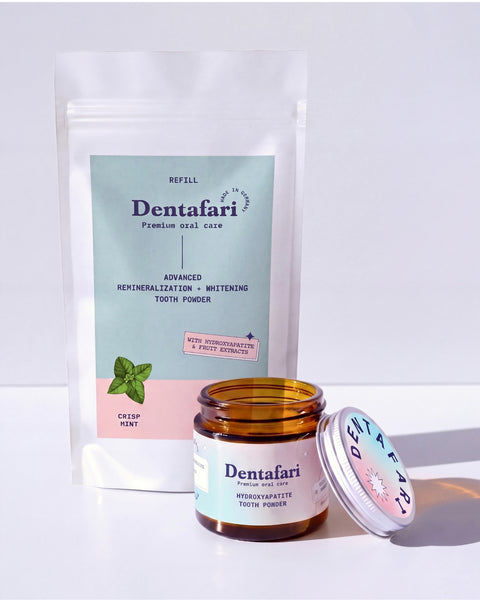
Gentle care for sensitive teeth: hydroxyapatite supports the natural remineralisation of tooth enamel, xylitol contributes to a balanced oral environment, and the postbiotic (Lactobacillus plantarum HEAL19) supports the natural balance of the oral flora. Mildly formulated, no nano particles. Mineral · With plant-based ingredients · Refillable · Made in Germany.
What do enzymes do in oral care?
Enzymes are the second pillar of microbiome oral care, and they work quite differently from a disinfectant. They don’t kill, they break things down. They loosen the sticky matrix of the biofilm, complement systems your saliva uses anyway, or loosen the protein layer that stains cling to. Research describes three approaches.
First, there are the salivary enzymes such as lactoperoxidase, glucose oxidase and lysozyme. Your saliva produces them itself, and some toothpastes add them. After just over three months with such an enzyme-protein toothpaste, the plaque of 111 study participants looked different in the laboratory: more of the species that belong to a healthy mouth, fewer of those associated with gum problems [12]. A 26-week study with 251 participants found significantly more gum sites that no longer bled in the enzyme group [13].
Then there are enzymes that break down the biofilm matrix, such as mutanase, dextranase and glucanase. They attack the sugar chains that bacteria use to glue their biofilm together. In a saliva biofilm model, mutanase prevented over 90 per cent of biofilm formation and dissolved up to 73 per cent of existing biofilms [14].
And finally, the plant enzymes you may already know from the kitchen: papain from papaya and bromelain from pineapple. In a randomised study, plaque and gum scores improved after one month with a papain-bromelain toothpaste compared with the control group; the formula there also contained miswak and neem [15]. Papain and bromelain are valued for gently loosening protein-based deposits on which stains from coffee, tea or red wine build up. In our Crisp Mint flavour, the two work as a fruit enzyme duo; exactly how, we explain in the article “Enzymes in oral care: papain and bromelain explained”.
The common denominator of all three approaches: enzymes work selectively. They weaken the structure of plaque instead of steamrollering the entire microbiome.
Five things the microbiome trend is changing
- From “antibacterial” to “balance”. More and more research no longer asks how many bacteria to remove, but which ones to encourage. Research on targeted ingredients, enzyme toothpastes and postbiotics all points in the same direction.
- The strain matters, not the word “probiotics”. People interested in the topic now ask: which strain exactly? In what form? With what evidence? Manufacturers who name an isolated, declared strain and explain the principle earn trust. Natural ingredients you can read.
- Postbiotics are replacing live cultures in oral care. Live bacteria work in lozenges. In toothpaste or tooth powder, heat-treated postbiotics are the stable solution, and according to market analyses the fastest-growing segment.
- The mineral base is hydroxyapatite plus xylitol. Hydroxyapatite is the mineral your tooth enamel is around 97 per cent made of; it supports the natural remineralisation of tooth enamel. Bacteria can’t use xylitol; it supports a balanced oral environment. We give back what your teeth are already made of. How you assess fluoride is your decision; we’ve gathered the evidence in the article “Hydroxyapatite or fluoride?”.
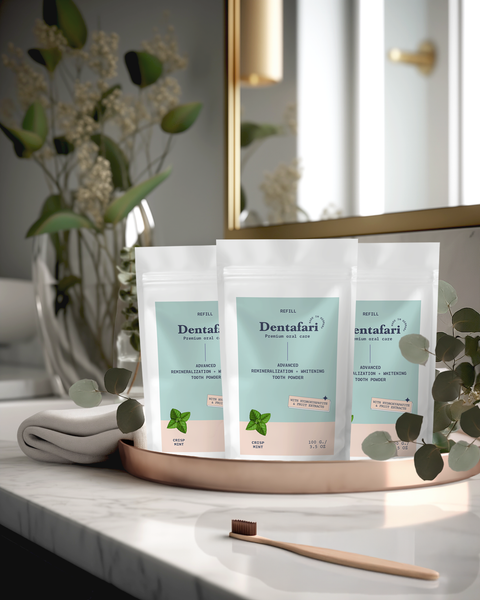
- Packaging is part of it. People interested in microbiome-friendly oral care usually look at the packaging too. The microbiome approach fits: mild formulas, few ingredients and, in the case of tooth powder, a refill pouch and an amber glass jar that stays.
| Question | Antibacterial approach | Microbiome approach |
|---|---|---|
| What’s the goal? | Reduce the number of bacteria | Support the balance of the oral flora |
| Typical ingredients | Chlorhexidine, CPC | Postbiotics, prebiotics, enzymes, xylitol, hydroxyapatite, mild surfactants |
| When is it useful? | For a limited time, e.g. after a procedure | Daily, long term |
| Evidence | Extensive, side effects documented | Growing, moderate, dependent on strain and product |
Building up your oral flora: a routine that supports your microbiome
After antibiotics, after a phase of chlorhexidine or simply because your mouth feels different: “How do I build my oral flora back up?” is the question we’re asked most often. The honest answer: with a routine that is unspectacular but reliable.
- Clean mechanically twice a day. Toothbrush and interdental brushes or floss remain the basis. No probiotic replaces brushing.
- Choose a microbiome-friendly tooth powder or a mild toothpaste, with mild surfactants, xylitol, hydroxyapatite and ideally postbiotics. Sprinkle a small amount of tooth powder onto the dry brush and brush gently.
- Clean your tongue. The coating on the tongue is the main reservoir for bad breath. Studies on Streptococcus salivarius K12 show that probiotics work against bad breath mainly when the tongue has been cleaned beforehand.
- Use antibacterial rinses only in a targeted way. Chlorhexidine is a tool for a limited time, for example after a procedure. Afterwards, the oral flora needs time and support.
- Feed the microbiome. Nitrate-rich foods such as rocket, spinach and beetroot nourish beneficial bacteria; frequent sugar hits favour the acid-producing species. Xylitol chewing gum after meals supports a neutral environment.
- Be patient. Studies report the first measurable changes after a few weeks; the microbiome stabilises over months. Two minutes in the morning, two in the evening, and then leave it be.
If your mouth often feels dry, it’s worth looking at saliva – what slows it down and what helps is in Dry Mouth: Why Saliva Matters So Much for Your Teeth.
The same applies to families, just with less menthol. When the founder’s son developed caries in his early years, she was told that’s just the way it is. Alena wanted to understand why – and found answers that weren’t in any bathroom cabinet. Dentafari grew out of that search. A fruity flavour for children aged three and up has been part of it from day one.

Fruity and mild, from age three: hydroxyapatite supports the natural remineralisation of tooth enamel, xylitol contributes to a balanced oral environment, and the postbiotic supports the natural balance of the oral flora. No nano particles. Mineral · With plant-based ingredients · Refillable · Made in Germany. Lovely when the whole family shares the same routine.
What we honestly don’t know yet
A brand that builds on studies also has to name their limits. The evidence for oral probiotics is promising but not conclusive. A critical review found only small differences in the gums in most studies, and the effects often wore off after a few months [11]. Many studies measure laboratory values such as bacterial counts rather than what you really care about. And results can’t be transferred from one strain to another.
The same honesty therefore applies to our postbiotic: it supports the natural balance of the oral flora and contributes to a balanced oral environment. It is not a medical device. If your gums bleed persistently, you’re in pain or bad breath won’t go away, that belongs in a dentist’s hands. Good oral care complements that; it doesn’t replace it.
Why we still think the trend is justified is shown by the overall picture: the mechanisms are biologically plausible, the evidence grows every year, blanket antibacterial strategies have documented side effects, and enzymes, xylitol and hydroxyapatite are well studied. Microbiome oral care is not a magic bullet. It’s an attitude that research increasingly shares.
Questions we’re often asked
What’s the difference between probiotics and postbiotics in oral care?
Probiotics are live bacteria intended to settle in the mouth; they work mainly in lozenges. Postbiotics are heat-treated bacteria that are no longer viable, with their cell structure preserved. They provide the complete bacterial spectrum, stay stable in toothpaste and tooth powder and need no refrigeration.
Do oral probiotics help with bad breath?
Partly, yes – best in combination with tongue cleaning. Studies with Streptococcus salivarius K12 show fewer volatile sulphur compounds, and a 2026 umbrella review confirms a noticeable improvement within a few weeks. If bad breath persists, the cause belongs in a dentist’s hands.
Where bad breath usually comes from and what helps day to day is explained in detail in Bad Breath: Where It Comes From and What Actually Helps.
Does a microbiome toothpaste contain fluoride?
That depends on the product. Some combine postbiotics with fluoride, others rely on hydroxyapatite, the mineral tooth enamel is made of, and xylitol. Dentafari uses hydroxyapatite and xylitol. Studies show different things – you decide; you’ll find the evidence in the article “Hydroxyapatite or fluoride?”.
How long does it take for oral probiotics to work?
Studies on oral probiotics usually report the first measurable changes after several weeks of daily use. How it is for you depends on the strain, product and routine; because effects wear off after stopping, continued use makes sense.
Is chlorhexidine mouthwash bad for the oral flora?
Within a week, chlorhexidine reduces bacterial diversity, lowers saliva pH and reduces nitrate-reducing bacteria. It is an effective agent for a limited time, for example after a procedure, and isn’t meant for everyday care.
Are microbiome toothpastes suitable for children?
That depends on the formulation. Our Orange-Mandarin flavour is intended for children aged three and up: mild and fruity, with hydroxyapatite, xylitol and a postbiotic. Children brush under supervision as always.
Oral care that works with your body
Probiotics and enzymes are changing oral care because they replace an old way of thinking: the bacteria aren’t the problem, the imbalance is. With hydroxyapatite, xylitol and the heat-treated postbiotic, we bring this idea into a tooth powder in a refill pouch, made in Germany by wb daily care GmbH in Stahnsdorf near Berlin. Treat yourself to two minutes just for you. And see how oral care feels when it works with your body instead of against it.
Your new oral care starts here.
Discover the Sensitive tooth powder Soothing Mint with hydroxyapatite, xylitol and a postbiotic. Mineral · With plant-based ingredients · Refillable · Made in Germany.
Discover now →Sources
- Grand View Research: Oral Microbiome Products Market Report. https://www.grandviewresearch.com/industry-analysis/oral-microbiome-products-market-report
- Rosier BT, Marsh PD, Mira A (2018): Resilience of the Oral Microbiota in Health. J Dent Res 97(4):371–380. https://doi.org/10.1177/0022034517742139
- Bescos R et al. (2020): Effects of Chlorhexidine mouthwash on the oral microbiome. Sci Rep 10:5254. https://doi.org/10.1038/s41598-020-61912-4
- Gruner D, Paris S, Schwendicke F (2016): Probiotics for managing caries and periodontitis: Systematic review and meta-analysis. J Dent 48:16–25. https://doi.org/10.1016/j.jdent.2016.03.002
- Tang et al. (2026): Umbrella review of probiotics in oral health. Front Oral Health. https://doi.org/10.3389/froh.2026.1768508
- Schlagenhauf U et al. (2020): Regular consumption of a Lactobacillus reuteri lozenge improves periodontal health in marines. J Periodontol 91(10):1328–1338. https://doi.org/10.1002/JPER.19-0393
- López-Valverde N et al. (2022): Probiotics for halitosis: systematic review and meta-analysis. Front Nutr. https://doi.org/10.3389/fnut.2021.787908
- Salminen S et al. (2021): ISAPP consensus statement on the definition and scope of postbiotics. Nat Rev Gastroenterol Hepatol 18:649–667. https://doi.org/10.1038/s41575-021-00440-6
- Piqué N, Berlanga M, Miñana-Galbis D (2019): Health Benefits of Heat-Killed (Tyndallized) Probiotics. Int J Mol Sci 20:2534. https://doi.org/10.3390/ijms20102534
- Iwasaki K et al. (2016): Daily intake of heat-killed Lactobacillus plantarum L-137 in supportive periodontal therapy. Oral Health Prev Dent 14(3):207–214. https://doi.org/10.3290/j.ohpd.a36099
- Baddouri L, Hannig M (2024): Probiotics as an adjunctive therapy in periodontitis treatment. npj Biofilms Microbiomes 10:148. https://doi.org/10.1038/s41522-024-00614-5
- Adams SE et al. (2017): A randomised clinical study to determine the effect of a toothpaste containing enzymes and proteins on plaque oral microbiome ecology. Sci Rep 7:43344. https://doi.org/10.1038/srep43344
- Hu D et al. (2025): Enzyme- and protein-containing toothpaste and gingival health: 26-week RCT. BMC Oral Health. https://doi.org/10.1186/s12903-025-07096-7
- Rikvold PD et al. (2024): The Effect of Enzymatic Treatment with Mutanase, Beta-Glucanase and DNase on a Saliva-Derived Biofilm Model. Caries Res 58(2):68. https://doi.org/10.1159/000535980
- Tadikonda A et al. (2017): Anti-plaque and anti-gingivitis effect of Papain, Bromelain, Miswak and Neem containing dentifrice. J Clin Exp Dent 9(5):e649. https://doi.org/10.4317/jced.53593
- Google Trends Germany, last 12 months (retrieved 10 September 2026): “microbiome toothpaste” (German search term; +1,900% as a rising query related to “microbiome”), “building up oral flora” (German search term).
Read more: Oral probiotics: what you should know about your oral flora · How to use tooth powder correctly · Packaging for tooth powder
Bestsellers
Comments (0)
There are no comments for this article. Be the first one to leave a message!