
Tooth Powder for Sensitive Teeth: What Matters in Gentle Oral Care
81 per cent. That’s how many adults have gums that have receded by one millimetre or more in at least one place – according to a 2025 meta-analysis that pooled the available evidence [1]. So sensitive teeth are nothing unusual. They’re one of the things most people get to know at some point.
More interesting than the number is what lies behind it. Because the causes often aren’t where you’d expect them – and it’s rarely just one.
Where sensitive teeth come from
The mechanism behind it is always the same. Somewhere, dentine – the layer beneath the enamel – is exposed. It’s crossed by tiny channels that reach all the way to the nerve. Cold, heat, sweet or sour sets the fluid in these channels moving – and that’s exactly what you feel [2].
There are several ways the dentine can become exposed. Receding gums are the most common. Then there are acids from food and drink that attack the enamel, and mechanical wear from brushing too hard. Teeth also react more sensitively for a while after tooth whitening or periodontitis treatment [2].
The same meta-analysis also looked at what encourages receding gums. At the top is untreated gum inflammation, followed by plaque and a high-attaching lip frenulum. Smoking and alcohol also appear [1].
Teeth grinding: the point few people think of
The same analysis includes a factor that rarely comes up in conversations about sensitive teeth: persistent overloading when biting. If you grind at night or clench during the day, you put repeated strain on the neck of the tooth in the same direction. The analysis found a clear link with receding gums [1], and reviews on hypersensitivity list the wedge-shaped defects at the neck of the tooth for the same reason [2].
The awkward part: very few people know they grind. Signs include a tense jaw in the morning, headaches at the temples, or worn surfaces that your dentist can see long before you feel them. A night guard belongs in the dental practice, not on the bathroom shelf – but it’s worth asking about at your next appointment.
Vitamin D: a link, not an answer
For some years, research has also been looking at vitamin D levels. An analysis of 16 studies with around 1,450 participants found lower average levels in people with periodontitis than in healthy comparison groups [3]. Whether a low level contributes or is more of a side effect can’t be concluded from this – the authors themselves point out large differences between the studies and advise cautious interpretation.
Studies show – you decide. And if the topic is on your mind: ask your doctor about it at your next appointment.
Whatever is behind it in your case – persistent or worsening discomfort should be checked by a dentist. Oral care is no substitute for a diagnosis. In everyday life, three things are in your own hands: brushing pressure, the right toothbrush and the right oral care.
What makes oral care mild
Whether oral care is really gentle is decided in places that are rarely printed large on the pack.
First, there’s the cleaning agent – how finely or coarsely it’s ground. Where tooth necks are exposed, this matters especially, because dentine is softer than enamel and is worn away more quickly. Then there are the surfactants that create the foam. Mild coconut-based surfactants clean while staying gentle on the lining of your mouth. And finally, the principle of action. For hypersensitivity, research describes two classic routes – sealing the open channels in the dentine or dampening the transmission of stimuli at the nerve [2]. Mineral oral care follows a third idea: giving the tooth back what it’s made of anyway.
Then there’s something that’s hard to measure. People who react sensitively often also find sharp flavours unpleasant – mild mint, or none at all, is then more pleasant than strong menthol.
Here’s how that looks for us. At the heart of the Sensitive flavours is hydroxyapatite – a calcium phosphate mineral and a natural component of tooth enamel. It provides calcium and phosphate, the natural building blocks of tooth enamel, and supports its natural remineralisation. At the same time, it contributes to smoothing the tooth surface – for a naturally whiter appearance through surface smoothing, no bleaching.
Our hydroxyapatite contains no nano particles, and that’s a deliberate decision. In March 2023, the European Commission’s scientific committee (SCCS) assessed hydroxyapatite in nano form as safe – but only under narrow conditions: for rod-shaped, uncoated particles without surface modification and up to a specified concentration. Studies on long-term effects with daily use are still lacking. Our particles are above 100 nanometres and therefore outside this definition. We’ve written up exactly what the EU assessment says in Hydroxyapatite tooth powder: safety of nano-hydroxyapatite.
On top of that comes Sodium Cocoyl Glutamate, a mild plant-derived foaming agent from coconut. It creates a gentle, fine foam that stays kind to the lining of your mouth – especially important when teeth and gums are already reacting sensitively.
The role of the postbiotic
Both Sensitive flavours contain a postbiotic with the strain Lactobacillus plantarum HEAL19 – gently heat-treated and therefore stable, with no live cultures. In the ingredients list, you’ll find it as “Lactobacillus Ferment”, bound to acacia gum (Acacia Senegal Gum).
It supports a healthy balance of the oral microbiota and so contributes to a balanced oral environment.
To put it in context: this postbiotic is the hallmark of our Sensitive line, not of all flavours. What sets probiotics, postbiotics and enzymes apart in oral care, and what the evidence says, is covered in detail in Microbiome toothpaste: probiotics and enzymes fact-checked.
Use it gently
How you use it plays its part too: a soft toothbrush (even if you use an electric toothbrush), little pressure, a small amount of powder, two minutes with a calm technique. The powder is taken out of the jar dry – so don’t dip a damp brush straight in. There’s more detail in How to use tooth powder correctly.
Which flavour suits you
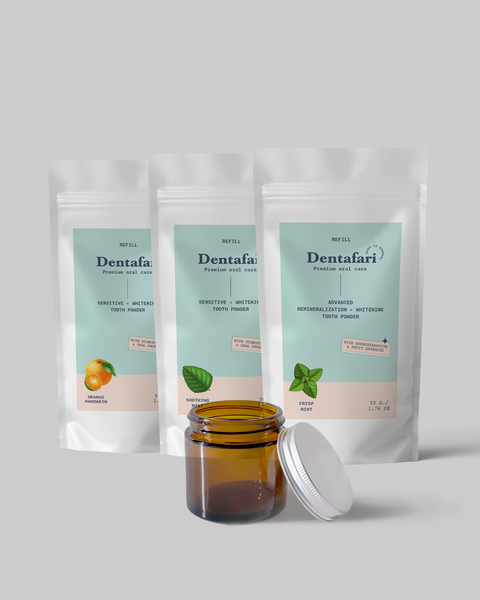
Between the two Sensitive flavours, it mainly comes down to taste. Both combine hydroxyapatite with a postbiotic, and both are mildly formulated.

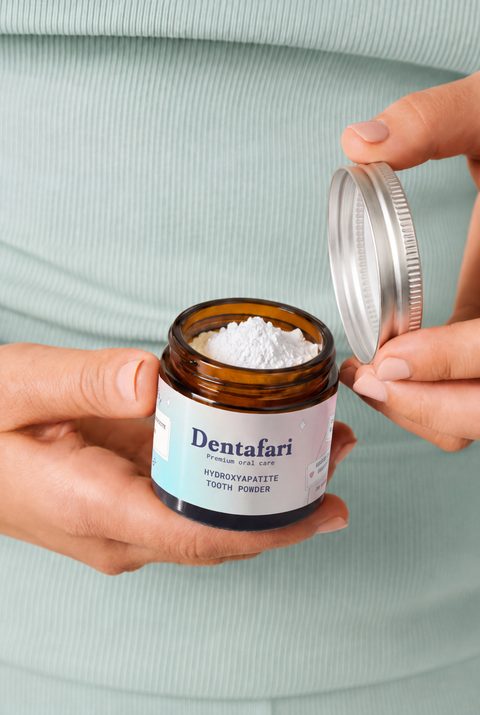
The mild mint option for sensitive teeth: hydroxyapatite supports the natural remineralisation of tooth enamel, xylitol contributes to a balanced oral environment, and the postbiotic supports the natural balance of the oral flora. Mildly formulated, no nano particles. Mineral · With plant-based ingredients · Refillable · Made in Germany.

Purely fruity, for children aged three and up and for anyone who’d rather skip mint in the morning. Hydroxyapatite supports the natural remineralisation of tooth enamel, xylitol contributes to a balanced oral environment, and the postbiotic supports the natural balance of the oral flora. No nano particles. Mineral · With plant-based ingredients · Refillable · Made in Germany.
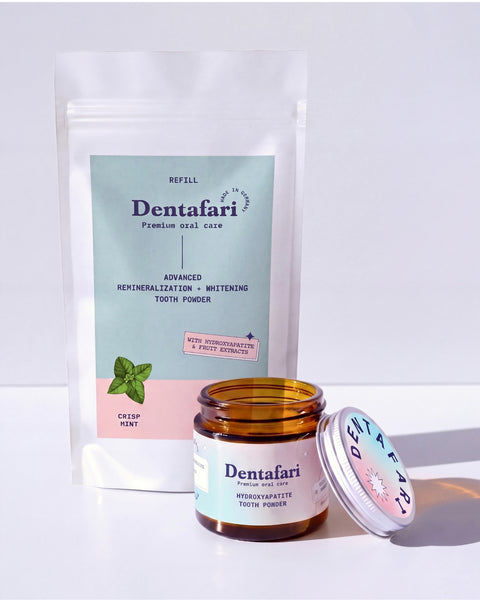
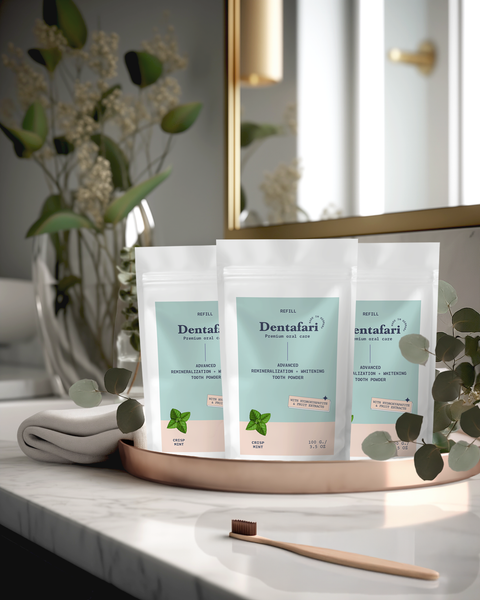
If your teeth cope well and you’re more concerned about stains, Crisp Mint is the flavour for you – with enzymes from pineapple and papaya as well as activated charcoal.
Your questions about sensitive teeth
Which tooth powder is suitable for sensitive teeth?
One with a mild formula. Our Sensitive flavours Orange-Mandarin and Soothing Mint combine hydroxyapatite with a postbiotic and a mild coconut-based foaming agent.
Can teeth grinding cause sensitive teeth?
Persistent overloading when biting is considered one of the factors that encourage receding gums, and reviews attribute the wedge-shaped defects at the neck of the tooth to it. If you wake up with a tense jaw, raise it at your dental practice.
Does vitamin D have anything to do with sensitive teeth?
Studies find lower average vitamin D levels in people with periodontitis than in healthy comparison groups. Whether this is a cause or a side effect remains open – the evidence is inconsistent. If you want to know your level, have it checked by a doctor.
How do I use tooth powder if I have sensitive teeth?
With a soft toothbrush – electric ones included – little pressure and a small amount of powder, for two minutes with a calm technique. The powder is taken out of the jar dry.
What does the postbiotic in tooth powder do?
The heat-treated strain Lactobacillus plantarum HEAL19 supports a healthy balance of the oral microbiota and contributes to a balanced oral environment. It contains no live cultures.
Why doesn’t Dentafari use nano-hydroxyapatite?
The 2023 EU safety assessment only applies to narrowly defined nanoparticles, and long-term data for daily use are lacking. Our hydroxyapatite is above 100 nanometres and doesn’t fall under this definition.
Not sure which flavour suits you? The Starter Set combines one flavour of your choice with the amber glass jar – a calm starting point for your two minutes in the morning and evening. All flavours and sizes are in the tooth powder overview.
Your new oral care starts here.
Discover the Sensitive tooth powder Soothing Mint with hydroxyapatite, xylitol and a postbiotic. Mineral · With plant-based ingredients · Refillable · Made in Germany.
Discover now →Sources
- Marschner F et al. (2025): Systematic review and meta-analysis on prevalence and risk factors for gingival recession. J Dent 155:105645. https://doi.org/10.1016/j.jdent.2025.105645
- Liu X et al. (2020): Pathogenesis, diagnosis and management of dentin hypersensitivity: an evidence-based overview for dental practitioners. BMC Oral Health 20:220. https://doi.org/10.1186/s12903-020-01199-z
- Liang F et al. (2023): Association of vitamin D in individuals with periodontitis: an updated systematic review and meta-analysis. BMC Oral Health 23:387. https://doi.org/10.1186/s12903-023-03120-w
Bestsellers
Comments (0)
There are no comments for this article. Be the first one to leave a message!