
Brightening Teeth Naturally: What Works and What Doesn’t
“Teeth whitening” is one of the most searched terms in oral care – and one of the most over-promised. This article sorts out what’s behind it: what can actually be changed at home, what can’t, and how to tell whether a method delivers what it claims.
Two things that often get confused
The colour of your teeth comes from two places. On the surface sit external stains – deposits from coffee, tea, red wine, spices or smoke. Beneath lies the tooth’s natural colour, determined by the dentine, which is naturally more yellow than the enamel above it.
This distinction decides everything. Oral care can loosen external stains. It can’t change the natural colour – that takes bleaching agents, and they belong in the hands of a dentist. Anyone who lumps the two together inevitably promises too much.
What mineral oral care does
Hydroxyapatite is the mineral tooth enamel is naturally made of. In oral care, it contributes to smoothing the tooth surface. A smoother surface reflects light more evenly – the tooth looks brighter without anything being bleached. The technical term for this is light reflection, and it’s an optical effect, not a chemical one.
There’s also a second route. An ultra-thin protein film, the pellicle, forms on every tooth. Stains cling to it. The plant enzymes papain from papaya and bromelain from pineapple loosen this film so that clinging stains can be rinsed away as you brush. They also help reduce the build-up of new external stains.
Together, both give a naturally whiter appearance – through surface smoothing and loosening external deposits, not through bleaching. There’s more about the two enzymes in Enzymes in oral care: papain and bromelain.
Why patience is part of it
With mineral oral care, a visible difference appears after six days of regular use at the earliest, often later. That’s not a drawback, but a result of how it works: nothing is bleached; the surface is smoothed and external deposits are loosened.
Anyone promising dazzling white teeth after 48 hours means something else – usually peroxides. They work faster, but they are an intervention, not a care step.

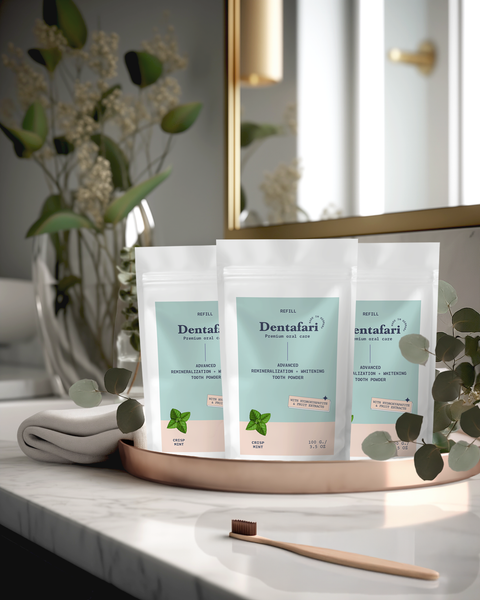
Papain and bromelain loosen the protein film on which external stains settle, and hydroxyapatite contributes to smoothing the tooth surface – for a naturally whiter appearance, no bleaching. No nano particles. Mineral · With plant-based ingredients · Refillable · Made in Germany.

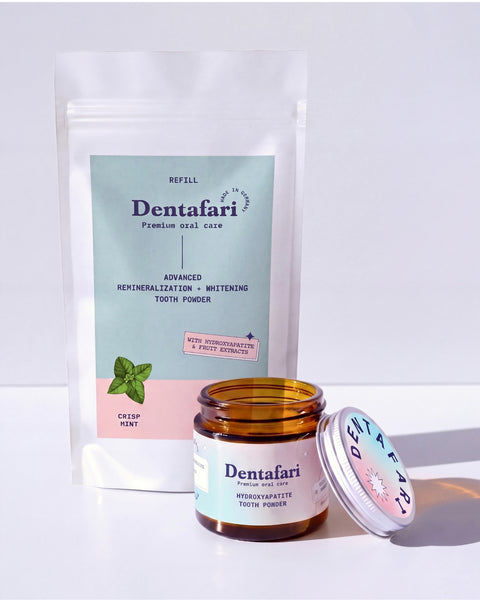
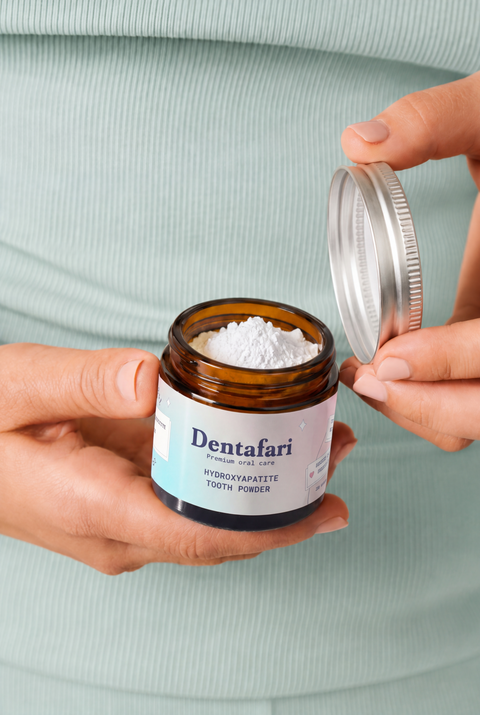
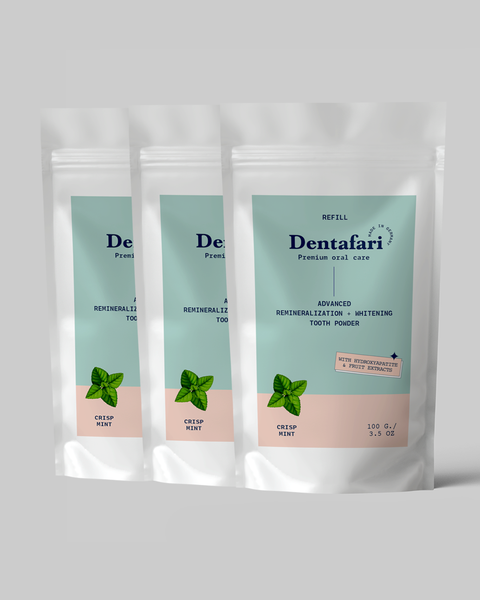
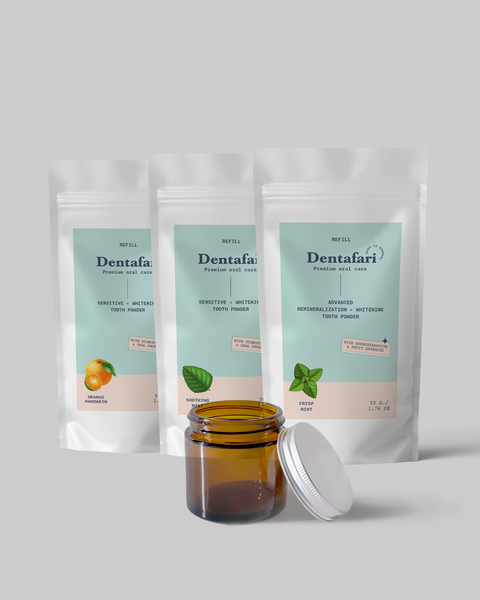
One flavour of your choice – Crisp Mint, for example – together with the amber glass jar and aluminium screw lid. The jar stays; you refill it with the refill pouch. Mineral · With plant-based ingredients · Refillable · Tooth powder made in Germany.
You’ll find all flavours and sizes in the tooth powder overview.
How to spot a questionable method
Three signals are worth a second look:
A number without context. “Three shades lighter” sounds measurable, but usually refers to a colour scale under study conditions – not your tooth after four weeks of everyday life.
A promise without a timeframe. Every method that works on the surface needs repetition. If no duration of use is given, the crucial part is being left out.
A result without reference to the cause. Stains have reasons. If a method doesn’t say what kind of stain it works against, it probably works against none.
Where stains come from in detail is explained in Why are my teeth yellow. If you’d like to see the different methods side by side, you’ll find them in Tooth whitening methods at a glance.
What’s in your own hands
The biggest lever isn’t the product, it’s repetition. Twice a day for two minutes, soft brush, little pressure. And be more aware of the things that encourage staining – not cutting them out, but knowing that coffee, tea and red wine leave their marks and that regular care counteracts them.
And the honest part to finish: tooth position, tooth shape and natural colour are individual. Oral care changes what sits on the tooth. What the tooth naturally is, stays.
Your questions about brightening
Can you really brighten your teeth at home?
External stains from coffee, tea, red wine or smoke can be loosened – they sit on the tooth surface. Your tooth’s base colour, on the other hand, lies in the dentine beneath and can’t be changed this way. If you want more, you end up with bleaching agents, and that belongs in a dental practice.
How long does it take to see something?
With mineral oral care, a difference becomes visible after six days of regular use at the earliest. If you expect a result after two days, you’ll be disappointed.
What’s the difference between brightening and bleaching?
Brightening means loosening stains from the surface and smoothing the surface so that it reflects light better. Bleaching changes the colour inside the tooth itself, using peroxides. One is cosmetic, the other an intervention.
What do papain and bromelain do here?
The two plant enzymes from papaya and pineapple loosen the thin protein film on the tooth where stains settle. Whatever comes loose, you rinse away as you brush.
Your new oral care starts here.
Discover Crisp Mint with hydroxyapatite, xylitol and the fruit enzymes papain and bromelain. Mineral · With plant-based ingredients · Refillable · Made in Germany.
Discover now →Bestsellers
Comments (0)
There are no comments for this article. Be the first one to leave a message!