
Teeth Whitening Methods at a Glance: Pros and Cons for Bright White Teeth
For over 4,000 years, people have tried to brighten their teeth. Methods have changed. Some for the better — some not.
How it all began with peroxides
Modern tooth brightening has its roots in ancient Egypt, where pumice powder was mixed with vinegar to create a bleaching paste. Rather experimental. In the late 19th century, dentists began using chlorine. In the 20th century, hydrogen peroxide followed — initially celebrated as progress, until it became clear how aggressive it can be on gums and mucous membranes.
In 1989, carbamide peroxide came along — a combination of hydrogen peroxide and urea, milder than its predecessors, but still peroxide-based. Today, both substances continue to dominate the market. And they carry warning labels you wouldn't normally expect on a care product: do not swallow, avoid contact with gums, observe precise application time.
What regulation says
Different countries have regulated peroxide-containing tooth brightening products differently:
- EU: Cosmetics with more than 6% hydrogen peroxide are banned. Products with up to 0.1% may be sold directly to consumers — products with 0.1–6% only through dentists.
- Japan: Hydrogen peroxide in cosmetics is completely banned.
- Canada: Products with more than 3% hydrogen peroxide must carry strict safety evidence and warning labels.
- USA: Peroxide-containing tooth brightening products are considered cosmetics and are not subject to FDA approval requirements.
PAP: a newer alternative
Phthalimidoperoxycapronic acid — or PAP for short — is a synthetic organic acid that also has a brightening effect, but does not release free radicals. Free radicals are what cause irritation with peroxides: the sensitive tissue of gums and oral mucous membranes often reacts with burning, redness or swelling.
PAP foregoes this mechanism. When products are labelled "PAP+", it means they additionally contain hydroxylapatite — a mineral valued for its ability to support natural remineralisation of tooth enamel.
Home remedies for brightening — honestly assessed
Many home remedies circulate online: baking soda, turmeric, oil pulling, strawberries. Some are harmless, some rather rough — pure baking soda or salt, for example, can roughen the tooth surface. A well-formulated recipe with finely ground particles is gentler than scrubbing with coarse home remedies.
Natural tooth brightening with Dentafari
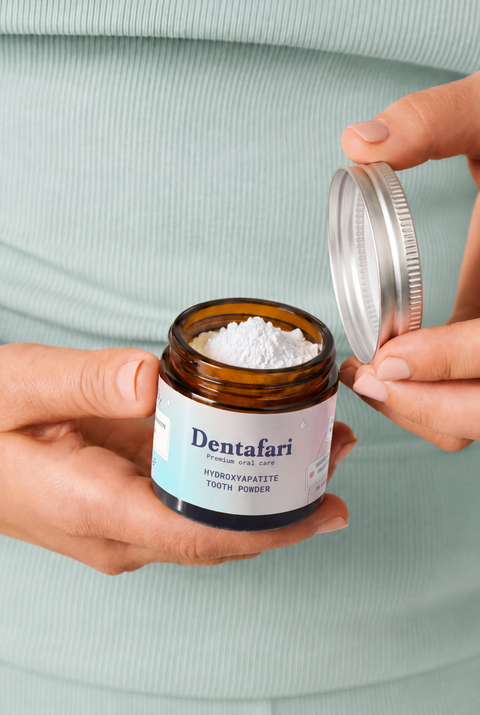
Dentafari works without peroxides and without PAP. We take a different approach: the mechanical and enzymatic action of natural ingredients.
- Hydroxylapatite — the mineral your tooth enamel is made of. It supports natural remineralisation and contributes to a naturally brighter appearance by smoothing the tooth surface.
- Papain and bromelain — plant enzymes from papaya and pineapple. They are valued for gently removing surface discolouration without requiring abrasive polishing agents.
- Calcium carbonate — a mild, mineral abrasive for gentle tooth surface cleansing.
- Sodium Cocoyl Glutamate — our mild surfactant from coconut oil, which ensures even distribution of ingredients in the mouth, without SLS.
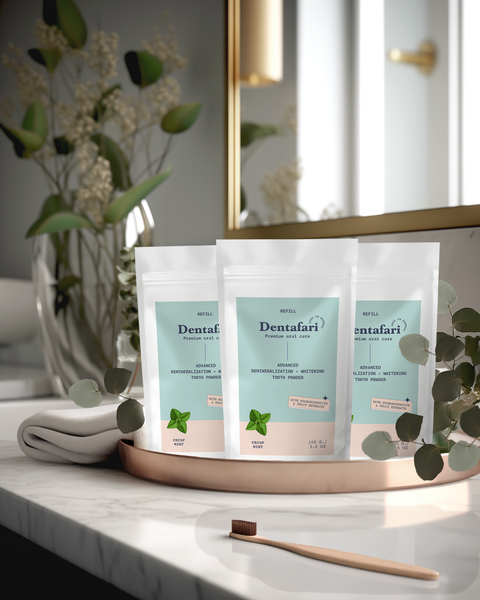
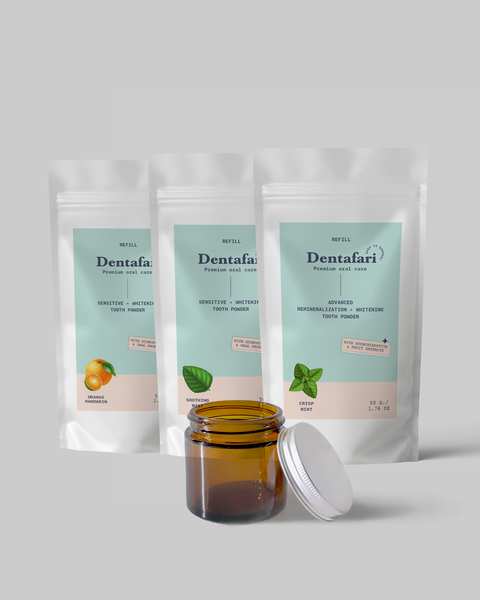
The result: a tooth powder that works without peroxides and bleaching agents. Discover our tooth powder and check the ingredients page to see exactly what's in it.
More at a glance: What is hydroxylapatite?
Your questions about natural brightening
How can I brighten my teeth naturally?
By gently removing external discolouration and smoothing the tooth surface — for example with hydroxylapatite and plant enzymes. This gives you a naturally brighter appearance, without any bleaching.
Does activated charcoal brighten teeth?
There is a lack of solid scientific evidence for activated charcoal as a brightener, and rough applications can strain the tooth surface. We rely on hydroxylapatite and plant enzymes instead.
How quickly will you see results?
A naturally brighter appearance develops gradually, not overnight — gentleness pays off.
Bestsellers
Comments (0)
There are no comments for this article. Be the first one to leave a message!