

How much hydroxyapatite is really necessary in toothpaste?
Why we don’t publish percentages for hydroxyapatite – and what really matters
Many people ask us: How much hydroxyapatite is in your tooth powder? – Our answer may surprise you: we deliberately give no percentage. Why? Because the amount alone says nothing about how effective it actually is. In this article, we explain what really matters – and what we look for in our hydroxyapatite.
More doesn’t mean better
At first glance, percentages look like a mark of quality: more active ingredient, more effect. But it isn’t that simple. A number without context says nothing about how well the mineral reaches the tooth surface – and that’s exactly what counts.
Why we don’t publish concentrations
At Dentafari, we deliberately don’t publish an exact concentration because, on its own, it says nothing about the quality or effect of the product. Without background knowledge, percentages are easily misinterpreted – and the actual product quality stays in the dark.
The decisive factors: quality, structure & origin
Our hydroxyapatite contains no nano particles; the particle size is above the nano threshold of 100 nanometres. It is highly porous, has a structure similar to tooth enamel and a balanced calcium-to-phosphate ratio, and so supports the natural remineralisation of tooth enamel. We’ve written about the nano question in detail here.
What makes our hydroxyapatite so special?
Our HAp is specially functionalised. This means that, thanks to its structure, it supports the natural remineralisation of tooth enamel and contributes to smoothing the tooth surface. Read more about it here.
Our formula with functionalised HAp
- supports the natural remineralisation of tooth enamel
- contributes to smoothing the tooth surface
- for a smooth feel on your teeth
- gives a naturally brighter appearance through surface smoothing

With the fruit enzymes papain and bromelain and activated charcoal from coconut shells. Hydroxyapatite supports the natural remineralisation of tooth enamel and contributes to smoothing the tooth surface – for a naturally whiter appearance, no bleaching. No nano particles. Mineral · With plant-based ingredients · Refillable · Made in Germany.
Your questions about it
Why doesn’t Dentafari state a percentage for hydroxyapatite?
Because a single number without context says little. What matters is the quality of the mineral, its structure and how it’s integrated into the whole formula.
Does more hydroxyapatite automatically mean more effect?
No. The amount alone says nothing about how available the mineral is at the tooth surface. Structure and processing play a bigger role than the concentration alone.
How can I recognise good hydroxyapatite?
By three things: whether it’s stated if nano particles are included, a fully readable ingredients list, and whether the manufacturer explains where the mineral comes from.
Does your tooth powder contain nano particles?
No. We use functionalised natural hydroxyapatite with a particle size above the nano threshold of 100 nanometres.
Real dental health takes more than a percentage
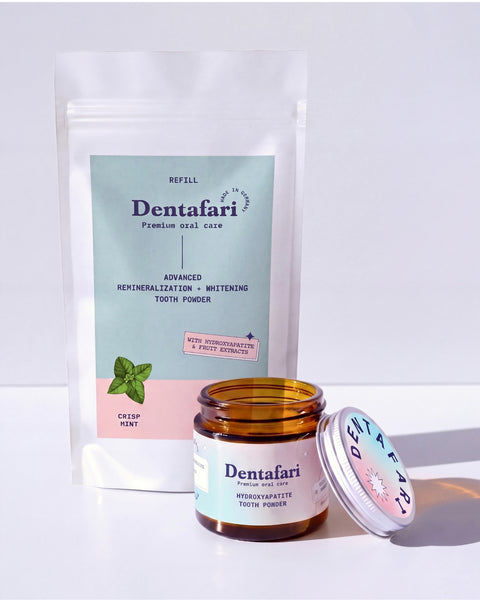
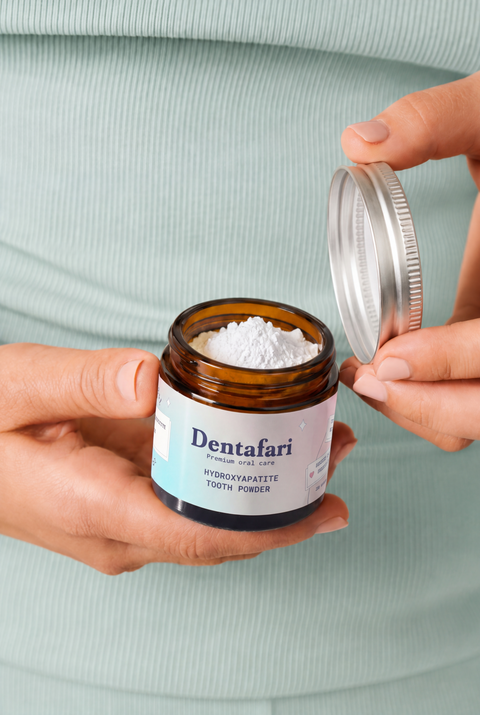
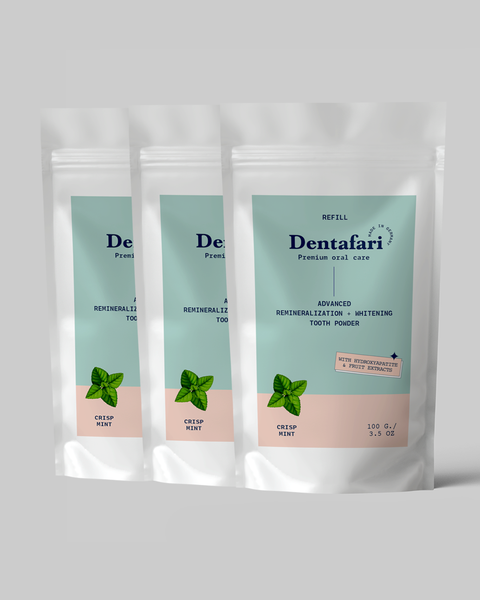
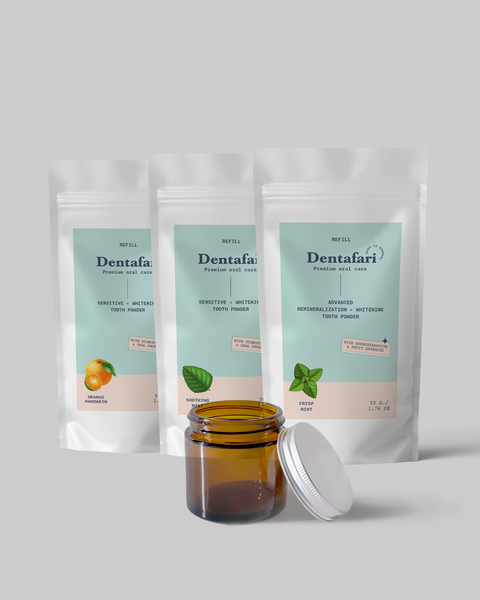
At Dentafari, we focus on effectiveness through quality – not on eye-catching numbers. For us, transparency means you should understand what works, not just how much of it is in there. You’ll find tooth powder with hydroxyapatite in all flavours and sizes in our shop, for example as the Crisp Mint refill.
Your new oral care starts here.
Discover Crisp Mint with hydroxyapatite, xylitol and the fruit enzymes papain and bromelain. Mineral · With plant-based ingredients · Refillable · Made in Germany.
Discover now →Bestsellers
Comments (3)
Buenos dias:
Estoy en chia cundinamarca,(Colombia), hacen domicilio ?
Cual es su contacto ?
Buenos dias:
Estoy en chia cundinamarca,(Colombia), hacen domicilio ?
Cual es su contacto ?
Hallo!
Ich befinde mich in der Ausbildung zur Zahnmedizinischen Fachangestellten in Schweden. Zwei meiner Mitschülerinnen und ich möchten eine Abschlussarbeit über den Wirkstoff Hydroxyapatit in Mundpflegeprodukten schreiben und sind nun auf der Suche nach fundierten Informationen. Wir wären sehr erfreut, wenn Sie uns auf folgende Fragen antworten könnten. Vielen Dank im Voraus.
-Warum verwenden Sie Hydroxyapatit in Ihren Produkten?
-Haben Sie sich dabei auf Studien oder Forschungsergebnisse gestützt? Wenn ja, auf welche?
-Sind die Produkte als Ergänzung oder als Ersatz für Fluorid gedacht?
-Wie stehen Sie zu Empfehlungen für sensible Zielgruppen wie beispielsweise Kleinkindern oder Schwangeren ?
-Beobachten Sie eine steigende Nachfrage nach Produkten mit Hydroxyapatit und falls ja, verfügen Sie über Statistiken, die Sie mit uns teilen können? (Wir sind meist an Daten für Schweden oder alternativ Skandinavien interessiert)
Noch einmal vielen Dank.
Mit freundlichen Grüßen
Ines, Tina und Anita